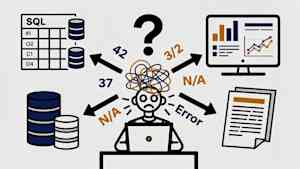
Enterprise AI agents are becoming more powerful, but their outputs aren’t necessarily more reliable. When multiple systems—from business intelligence dashboards to SQL tables—query the same underlying data, they often arrive at conflicting conclusions. This isn’t a flaw in the AI models themselves, but rather a gap in how enterprise data is defined and shared across tools. At Snowflake Summit 2026, the company introduced a context layer designed to standardize business logic and prevent agents from reasoning over fragmented schemas.
The fragmented reality of enterprise data
Today’s enterprise AI stacks rely on retrieval architectures that prioritize speed and cost efficiency over consistency. While vector search has improved, it hasn’t resolved a fundamental issue: the same dataset can yield different interpretations depending on which agent or tool requests it. Revenue figures might mean one thing in a BI dashboard, another in a SQL query, and yet another in an agent’s instructions. This inconsistency creates a critical blind spot in enterprise AI deployments, where confidence in outputs doesn’t guarantee accuracy.
Christian Kleinerman, Snowflake’s EVP of Product, highlighted this tension during the event. "There are plenty of tools where you can ask a question and receive a very confident answer," he noted, "but whether it’s correct is a different story." The issue stems from distributed business logic—SQL schemas, BI dashboards, and agent instructions all define meaning differently, leaving no single system accountable for a shared truth.
Introducing a two-layer solution: explicit and implicit context
Snowflake’s answer to this problem is a dual-layer context system: Horizon Context and Cortex Sense. Horizon Context acts as a customer-managed semantic layer, built on the company’s acquisition of Select Star. It aggregates metadata from sources like Postgres, SQL Server, Tableau, and Power BI into a unified catalog, ensuring every agent, BI tool, or external system references the same governed definitions. Semantic View Autopilot further automates this process by dynamically creating and refining semantic views, reducing the need for manual curation.
Cortex Sense complements Horizon Context by automatically deriving context from enterprise data and usage patterns. Unlike Horizon Context, which relies on explicit customer definitions, Cortex Sense operates implicitly, enriching default experiences without requiring upfront configuration. Kleinerman emphasized the separation: "Horizon Context covers everything explicitly declared by customers, while Cortex Sense handles what’s derived by the platform."
These layers integrate with Snowflake’s existing retrieval infrastructure, including Cortex Search, which powers RAG implementations for tools like CoCo and Cowork. The result is a governed, shared definition of business logic that agents can trust, regardless of how they query the data.
Open standards and interoperability take center stage
Snowflake isn’t positioning Horizon Context as a proprietary solution. The company is actively contributing to the Open Semantic Interchange initiative, ensuring that customer-declared definitions remain portable across third-party catalogs and tools. "Horizon Context is 100% committed to leading this effort to prevent vendor lock-in," Kleinerman stated. This approach aligns with growing industry demand for open, interoperable semantic layers—a trend reflected in recent moves by competitors.
Microsoft, for example, has opened its Fabric IQ business ontology via MCP, allowing agents from any vendor to access a shared semantic layer. Redis launched Iris, a context platform designed to sit between agents and data, optimized for the retrieval volumes required by large-scale AI deployments. Meanwhile, Pinecone is rebranding its vector database as a knowledge engine with Nexus, which pre-compiles enterprise data into task-specific artifacts before agents interact with it.
Analysts weigh in: Why context layers are the next AI battleground
Industry analysts see context layers as the critical differentiator for agentic AI. Devin Pratt, research director at IDC, praised Snowflake’s approach, noting that agents are only as reliable as the data and semantics behind them. "The context layer is where the real competition is unfolding," he said. "Snowflake’s split between explicit and implicit context is a smart architectural choice, anchoring Horizon Context within the catalog and governance layer rather than retrofitting it later."
Mike Leone, VP and principal analyst at Moor Insights and Strategy, echoed this sentiment. "Separating context into two buckets—one for explicit definitions and another for platform-derived insights—is the right move," he explained. "This dual-layer approach ensures both precision and adaptability, addressing the core challenge of maintaining consistency in enterprise AI."
A forward-looking vision for enterprise AI
As enterprises scale their AI deployments, the need for a shared, governed context layer will only intensify. Snowflake’s dual-layer strategy offers a practical path forward, balancing customer control with platform-driven adaptability. By standardizing how data is interpreted across tools, the company aims to bridge the gap between confidence and correctness—a critical step toward building trust in enterprise AI systems.
The broader industry is taking notice, with competitors and partners alike racing to define the semantic standards that will underpin the next generation of AI agents. For enterprises, the message is clear: the future of AI isn’t just about smarter models, but about smarter, more consistent data.
AI summary
İş zekası araçları ve AI ajanları aynı veriden farklı yanıtlar üretiyor. Snowflake'ın Horizon Context ve Cortex Sense ile sunduğu bağlam katmanı çözümü, veri tanımlarını standartlaştırarak güvenilirliği artırıyor.