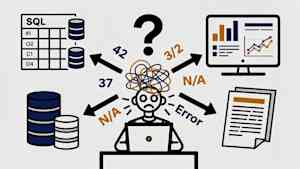
Procurement teams are quietly bypassing corporate controls by uploading contracts, invoices, and financial data into personal AI accounts like ChatGPT or Claude. A new wave of AI agents from Zip promises to automate these tasks while keeping sensitive information within governed, audit-ready systems.
The hidden cost of ungoverned AI in procurement workflows
Employees across enterprises are increasingly turning to AI tools to streamline labor-intensive tasks, but the practice is creating significant compliance risks. Contracts are redlined in personal ChatGPT accounts, spend data is analyzed in unmonitored Claude sessions, and internal financial reports are generated in personal Copilot or Gemini instances. Each interaction sends sensitive corporate data into environments lacking audit trails, compliance controls, or even basic oversight.
The stakes couldn't be higher. Audit failures under regulations like the Sarbanes-Oxley Act can trigger fines up to $25 million and even prison sentences for executives. When auditors request documentation months later, companies often can't provide records of how decisions were made, leaving them exposed to severe penalties.
Lu Cheng, CTO and co-founder of Zip, highlighted the scale of this issue in enterprise settings. "We've worked with hundreds of companies—including some of the biggest names in AI—and found that this kind of shadow AI use is already happening, whether governance exists or not." Even organizations building AI technologies are struggling to control these practices, he noted.
Zip CEO Rujul Zaparde emphasized that procurement represents a uniquely high-stakes domain for AI governance. Most enterprises don’t rely on a single procurement platform. Instead, they operate complex ecosystems spanning SAP for ERP, Coupa for sourcing, ServiceNow for IT requests, and dedicated contract management tools for legal and risk teams. This fragmentation creates blind spots where AI use can spiral out of control.
"AI can only be as effective as the data it can access," Zaparde explained. "Zip acts as an orchestration layer that connects these systems, giving our AI visibility into the entire procurement process—from initial request to final payment. This allows our agents to operate across workflows in ways that point solutions simply can’t."
How Zip’s five Superagents automate procurement’s toughest challenges
Zip is rolling out five specialized AI agents, each designed to address specific bottlenecks in the procurement lifecycle. These agents aren’t standalone tools but components of a unified system built on Zip’s App Studio workflow automation platform.
- Procurement Superagent: Unblocks stalled purchase requests and handles negotiations for low-value spend.
- Legal Superagent: Reviews and redlines contracts against company-approved templates and playbooks.
- AP Superagent: Automates invoice sorting, coding, matching, and routing to the appropriate teams.
- Config Superagent: Identifies workflow inefficiencies and drafts configuration changes for administrator approval.
- Intake Superagent: Guides employees through compliant request creation and routes purchases to preferred suppliers.
Under the hood, these agents share a common architecture. Zip’s engineering team describes their model as "Lego block"—each agent is essentially a configured instance of the same execution engine. The platform’s flexibility allows enterprises to build custom agents by adjusting prompts, tool access, and output formats without starting from scratch.
The agents operate through a four-stage LangGraph state graph: preprocessing, orchestration, synthesis, and post-processing. The orchestration node, powered by a ReAct (Reason + Act) agent, dynamically decides which tools to invoke—whether searching documents via vector databases or making API calls to connected systems.
Bridging enterprise data into AI assistants without losing control
Beyond the Superagents, Zip is introducing a procurement-native implementation of the Model Context Protocol (MCP). This innovation enables direct data streaming from Zip’s platform into third-party AI assistants like Claude or ChatGPT while preserving audit trails and compliance controls.
Traditionally, sending enterprise data to external AI tools means surrendering control over how it’s used. Zip’s MCP integration changes that equation. It pipes procurement data into AI assistants in a structured, traceable format, ensuring every interaction remains within the company’s governance framework.
The announcement comes at a pivotal moment for enterprise AI. Competitors like SAP and Coupa have recently unveiled their own AI-driven procurement solutions, with SAP’s "Autonomous Enterprise" vision and Coupa’s Compose platform aiming to automate similar workflows. Gartner forecasts that by the end of 2026, 40% of enterprise applications will include task-specific AI agents—up from less than 5% today.
Zip’s approach stands out by focusing not just on automation but on governance. By keeping AI interactions confined to controlled environments, the platform addresses a critical pain point for enterprises grappling with the rise of shadow AI.
As procurement teams continue to seek efficiency gains, the ability to automate complex workflows without sacrificing compliance will likely become a defining factor in enterprise AI adoption.
AI summary
Zip, finans ekiplerinin hassas verileri kişisel AI hesaplarına yüklemesini engelleyen yeni AI ajanlarını tanıttı. Kurumsal uyum ve denetim odaklı çözümler, tedarik süreçlerini otomatikleştirirken riskleri azaltıyor.