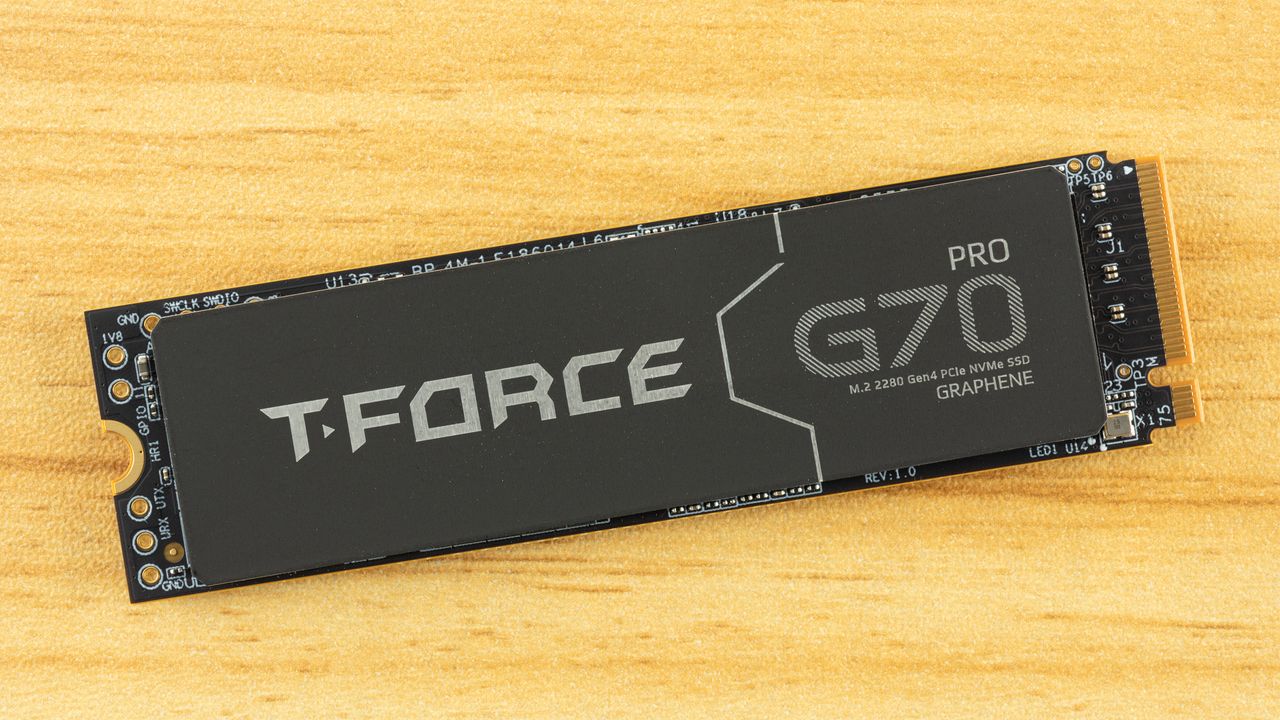
The storage market is crowded, but the TeamGroup G70 Pro stands out for its unusually strong combination of DRAM-equipped performance and competitive pricing—especially at the 2TB mark. Unlike many budget-focused drives that cut corners, the G70 Pro packs a PCIe 4.0 x4 interface, the InnoGrit IG5236 controller, and YMTC 232-layer TLC NAND to deliver sequential read speeds up to 7,400MB/s and write speeds of 6,600MB/s at the 2TB capacity. Yet, its true value isn’t just raw specs; it’s in how TeamGroup balances cost without sacrificing reliability.
A Drive Built for Varied Workloads—and Capacities
One of the G70 Pro’s most compelling features is its flexibility in capacity and cooling options. Available in 512GB, 1TB, 2TB, 4TB, and even 8TB, it caters to everything from budget builds to high-capacity workstations. At the time of testing, the 2TB model retailed for around $327, positioning it as a mid-range option that punches above its weight. The drive also comes in heatsink and non-heatsinked variants, with TeamGroup recommending the heatsink version for sustained workloads to manage thermal throttling—though even then, heat output remains a consideration for compact systems.
For users prioritizing DRAM caching, the G70 Pro’s 1GB DRAM per 1TB of storage ratio ensures consistent performance under heavy loads. The NAND itself is YMTC’s 232-layer TLC, a newer technology that improves efficiency and endurance. However, the 512GB model may struggle to hit peak speeds due to controller and flash limitations, making the 2TB or 4TB versions the sweet spot for most users.
Performance Quirks and Controller Considerations
The InnoGrit IG5236 controller is the heart of the G70 Pro, but its reputation has been mixed since launch. Early versions struggled with YMTC NAND compatibility, leading to reliability concerns. TeamGroup claims to have addressed these issues, and our testing suggests improvements—but the drive’s long-term stability still warrants caution. Compared to rivals like the Phison E18 or Silicon Motion SM2264, the IG5236 offers similar performance at a lower cost, yet its reliability remains a wildcard.
In synthetic benchmarks, the G70 Pro delivered:
- Sequential read speeds: Up to 7,400MB/s (2TB model)
- Sequential write speeds: Up to 6,600MB/s (2TB model)
- Endurance rating: 1,480TBW for the 2TB model (five-year warranty)
While random I/O performance wasn’t disclosed, the controller and NAND are rated for 700K–1,000K IOPS, placing it on par with high-end PCIe 4.0 drives. That said, real-world performance may vary based on system configuration and thermal conditions.
Software and Power Efficiency: What You Get (and Don’t)
TeamGroup bundles a basic SSD toolkit with the G70 Pro, including its S.M.A.R.T. monitoring utility for drive diagnostics. While useful for quick checks, it lacks advanced features like firmware updates or secure erase tools. For data backup and cloning, TeamGroup points users to third-party solutions like MultiDrive (Windows) or Clonezilla/Rescuezilla (cross-platform).
Power consumption is another area where the G70 Pro stays within expectations. The drive’s ~8.25W power rating aligns with typical high-performance SSDs, though actual draw in testing was lower. Still, the G70 Pro isn’t a power-saving champion—it’s designed for speed, not efficiency.
Is the TeamGroup G70 Pro Right for You?
The G70 Pro shines in high-capacity builds where price and performance matter more than bleeding-edge reliability. Its 2TB and 4TB models offer the best value, with speeds that rival top-tier drives while undercutting competitors like the Seagate FireCuda 530R at similar tiers. However, the 512GB model is best avoided due to performance limitations, and users in laptops or ultra-compact PCs should opt for the heatsink version to mitigate thermal throttling.
For budget-conscious power users, the G70 Pro is a strong contender—but don’t expect flawless consistency. TeamGroup’s efforts to stabilize the IG5236 controller are promising, but until long-term data is available, cautious buyers may want to stick with proven alternatives. If you’re building a mid-range workstation or content creation rig, though, this drive delivers where it counts: speed, capacity, and affordability.
The storage market evolves rapidly, but the G70 Pro proves that even in a crowded field, there’s still room for drives that balance innovation with practicality. As PCIe 5.0 drives become more accessible, the G70 Pro’s role as a high-value PCIe 4.0 option may shift—but for now, it’s a solid choice for those who prioritize performance without paying premium prices.
AI summary
TeamGroup G70 Pro SSD’nin DRAM destekli yapısı, yüksek performansı ve uygun fiyatıyla nasıl masaüstü sistemler için ideal bir seçenek olduğunu keşfedin.