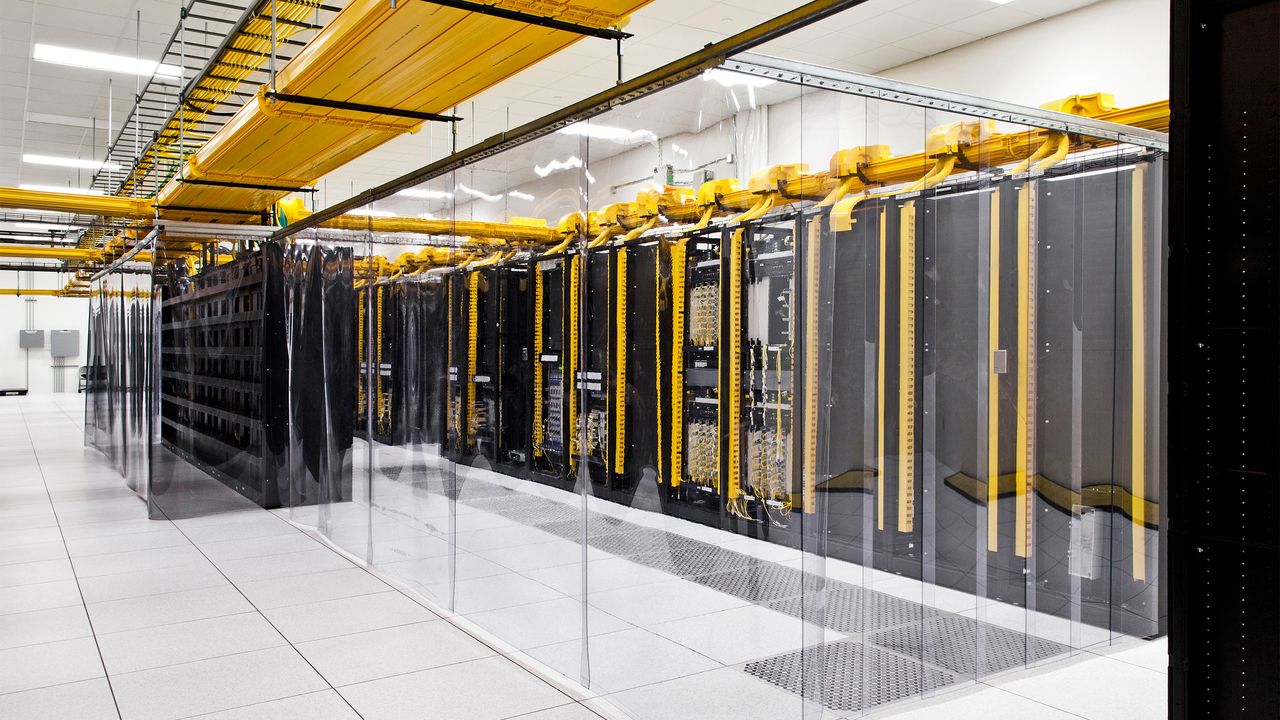
China’s National Supercomputer Center in Shenzhen (NSCS) has rewritten the high-performance computing (HPC) record books with the debut of LineShine, a groundbreaking supercomputer that now ranks as the world’s most powerful. The system delivered 2.198 FP64 ExaFLOPS in the Linpack benchmark, becoming the first machine in the Top500 list to sustain over 2 ExaFLOPS of double-precision performance using only CPUs. This achievement underscores China’s growing self-sufficiency in supercomputing technology and sets a new benchmark for the global HPC community.
A CPU-Only Powerhouse Built on Domestic Innovation
Unlike previous top systems that relied on hybrid architectures combining CPUs with accelerators like GPUs or AI chips, LineShine achieves its record-breaking performance entirely through 304-core LX2 processors developed in-house. These chips are based on the Armv9 instruction set architecture and operate at 1.55 GHz, leveraging Semi-custom chiplet design to optimize performance and power efficiency.
The supercomputer employs 13.79 million CPU cores across its massive system, interconnected by LingQi, a proprietary high-speed network designed to minimize latency and maximize data throughput. With a total power draw of 42.2 MW, LineShine delivers 52.07 GFLOPS/W in performance-per-watt—a notable achievement, though still trailing the U.S. system El Capitan (60.94 GFLOPS/W) in efficiency.
Outperforming Legacy Systems in Traditional HPC Workloads
While LineShine dominates the Top500 rankings, its performance in other critical benchmarks highlights its strengths and limitations. In the HPCG (High Performance Conjugate Gradients) test, which measures real-world scientific computing workloads, LineShine achieved 22.00 HPCG-PFLOPS, securing its place at the top. However, its results in HPL-MxP, a mixed-precision benchmark, reveal a different story: 7.92 EFLOPS—placing it behind competitors like El Capitan, Frontier, and Aurora.
This lower mixed-precision performance is expected given LineShine’s CPU-only architecture. The system excels in double-precision (FP64) workloads, which are critical for traditional HPC applications such as climate modeling, fluid dynamics, and large-scale simulations. Each LX2 CPU integrates SVE (Scalable Vector Extension) and SME (Scalable Matrix Extension) units, enabling efficient handling of vector and matrix operations. These units support a wide range of data formats, including FP64, FP32, BF16, FP16, and INT8, making the system versatile for both scientific computing and certain AI-related tasks.
Memory and Interconnect: The Backbone of LineShine’s Performance
A key factor in LineShine’s raw power is its hybrid memory architecture, which pairs 32 GB of on-package HBM (High Bandwidth Memory) with up to 256 GB of external DDR5 memory. This design provides up to 4 TB/s of bandwidth, ensuring rapid data access for memory-intensive workloads. However, the system’s 3.6X performance uplift when transitioning from FP64 to mixed-precision formats suggests room for improvement in memory bandwidth optimization and software maturity.
The LingQi interconnect plays a crucial role in maintaining system coherence, enabling seamless communication between the millions of cores. While this proprietary solution enhances performance, it also underscores the challenges of building a fully domestic supercomputer ecosystem—particularly in integrating advanced interconnects and memory subsystems without relying on foreign technologies.
Geopolitical Implications and Future Prospects
The emergence of LineShine as the new global leader in supercomputing carries significant geopolitical and technological implications. By relying exclusively on Chinese-designed hardware and software, NSCS has demonstrated that the country can achieve world-class HPC performance without dependence on U.S. or other foreign technologies—a move likely intended to mitigate risks from export restrictions.
Experts suggest that while LineShine’s CPU-only design may limit its versatility in AI training and inference, its exceptional FP64 performance solidifies its position as a leader in traditional supercomputing. The system’s success could accelerate further advancements in Arm-based HPC architectures, potentially inspiring new innovations in energy-efficient, high-performance computing.
As the global race for exascale computing intensifies, LineShine’s debut marks a pivotal moment—not just for China, but for the entire HPC industry. The question now is whether this CPU-centric approach will inspire a new wave of specialized, high-efficiency supercomputers, or if hybrid architectures will continue to dominate the top rankings.
AI summary
Çin’in Shenzhen’de geliştirilen LineShine süper bilgisayarı, 2,198 ExaFLOP performansıyla dünyanın en güçlüsü oldu. Sadece CPU’larla çalışan bu dev sistem, nasıl çalışıyor ve rakiplerine karşı ne gibi avantajlar sunuyor?