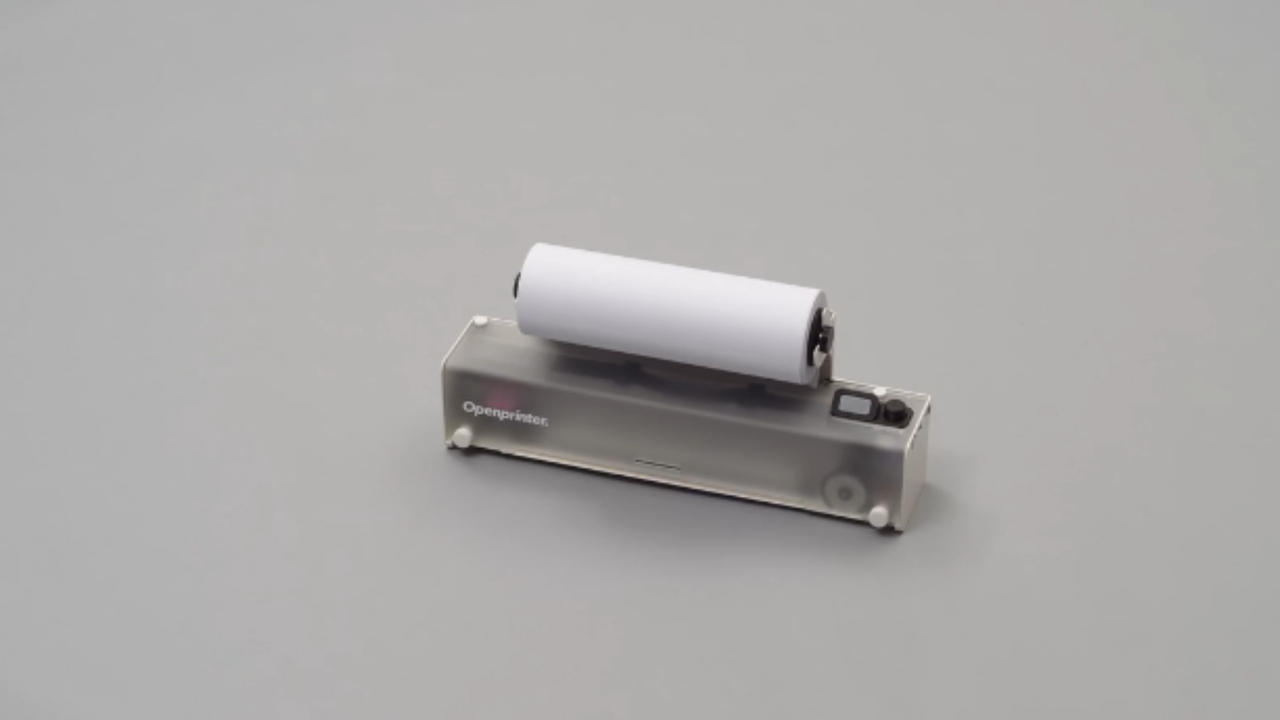
The frustration of owning a consumer printer is familiar: locked cartridges, forced subscriptions, and firmware that turns off functionality when ink levels are low. After decades of these practices, Paris-based Open Tools is developing the Open Printer, a DIY-friendly inkjet that returns control to users. The project’s first working prototype has been showcased in a new video, nearly a year after its initial reveal on Crowd Supply. While the device still lacks a confirmed release date, pricing, or print speed, its design files under Creative Commons BY-NC-SA 4.0 signal a bold step toward transparent, repairable hardware.
A printer built for repair and reuse
Open Tools’ prototype runs on a Raspberry Pi Zero W, with an STMicroelectronics STM32 microcontroller handling cartridge communication. Unlike traditional printers, it avoids DRM-chipped cartridges by using refillable HP models—specifically HP 63 in the U.S., HP 302 in Europe, and HP 803 in Asia—each compatible with open-source ink systems. The machine prints to cut sheets or paper rolls via an integrated cutter, supporting both black-and-white and color output. Black prints at 600 dpi, while color reaches 1200 dpi, all managed through CUPS, the open-source printing system that ensures compatibility with Windows, macOS, Linux, Android, and iOS without proprietary drivers.
The printer’s interface includes a 1.47-inch TFT LCD and a jog wheel, with connectivity options like USB-C, USB-A, Bluetooth 4.1, and a 24V DC input. Open Tools has confirmed the prototype can now print in monochrome and full color, though the team is still refining networking—Wi-Fi 5 support, exceeding the Pi Zero W’s built-in 802.11n radio, may require an additional module. Other ongoing work includes ink drying optimization, printhead cleaning cycles, paper insertion mechanics, and dithering algorithms to improve print quality.
Creative Commons licensing with limits
All electronics, firmware, mechanical files, and the bill of materials are shared under Creative Commons BY-NC-SA 4.0. This license allows users to repair, modify, and share the design for non-commercial purposes, but explicitly prohibits commercial production or resale. Open Tools argues this balances openness with sustainability, preventing third parties from mass-producing the printer without contributing to the ecosystem.
However, the project’s reliance on HP cartridge bodies—despite HP’s history of restrictive practices—introduces a critical dependency. The Open Printer only works with HP cartridges that incorporate integrated printheads, meaning its repairability hinges on HP’s continued production of these models. This choice is puzzling given HP’s past controversies, including its HP+ and Instant Ink programs, which locked users into subscription models until public backlash led to their discontinuation in 2024. Open Tools has not yet addressed how it plans to mitigate this risk or whether alternative cartridge ecosystems might be explored.
What’s next for Open Printer?
The project’s technical progress is evident, but commercialization remains a question mark. Open Tools has not set a crowdfunding funding goal, and the final price will depend on production volume, component costs, certification requirements, and unresolved engineering challenges. The company plans to share pricing details when its crowdfunding campaign launches in the coming months. In the meantime, the prototype’s nomination for two French Design Awards reflects growing interest in user-controlled hardware, though awards alone won’t solve the practical challenges of scaling an open-hardware printer.
The Open Printer represents more than just a new device; it’s a statement about ownership in the age of planned obsolescence. If successful, it could inspire a wave of transparent, repairable alternatives across the tech industry. For now, users will have to wait to see whether Open Tools can turn its promise of freedom into a practical, widely available solution.
AI summary
Paris merkezli Open Tools, DRM ve aboneliksiz açık kaynaklı Open Printer’ı tanıttı. İlk prototip videosu yayınlandı, ancak fiyat ve sevkiyat tarihi henüz belli değil. Teknik özellikler ve gelecek planları hakkında detaylar.