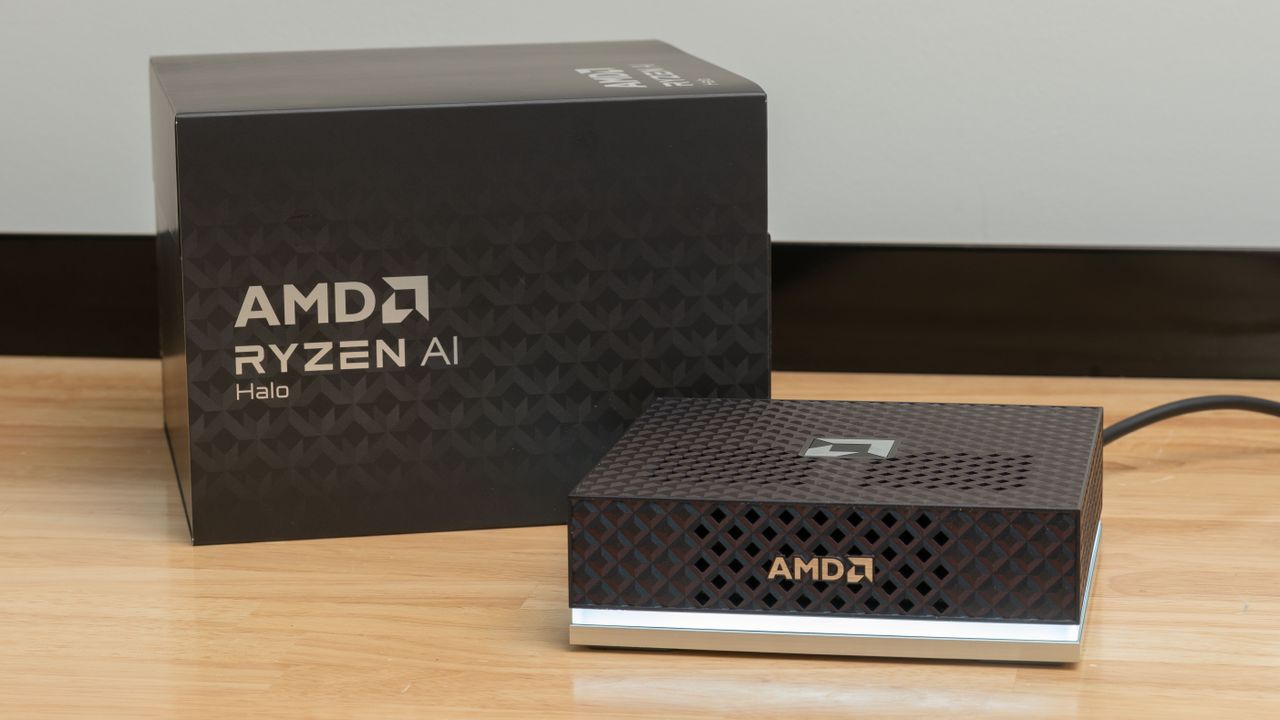
AMD is stepping into Nvidia’s local AI sandbox with a turnkey mini-PC that promises a faster on-ramp for developers eager to experiment with large language models. The new Ryzen AI Halo isn’t just another bare-metal box; it ships with the full AMD ROCm stack, a curated selection of inference engines, and first-party playbooks that mirror the user-friendly playbook strategy Nvidia pioneered with DGX Spark. After setting one up, we found its promise of plug-and-play AI experimentation compelling, but not without trade-offs.
A plug-and-play AI workstation built around Strix Halo
The Ryzen AI Halo is a compact system based on AMD’s Ryzen AI Max+ 395 (codenamed Strix Halo), a single-chip solution that combines a 16-core/32-thread Zen 5 CPU, a Radeon 8060S RDNA 3.5 iGPU, and an XDNA 2 NPU. It pairs this SoC with 128GB of unified LPDDR5X memory and a 2TB NVMe SSD, delivering a balance of bandwidth and capacity that should handle most local inference workloads without bottlenecks.
The system arrives preconfigured with a Debian-based Linux image or Windows 11, depending on the SKU. For Linux users, the out-of-box experience includes the AMD ROCm software stack and a collection of AI tools, which AMD says covers the common model formats like PyTorch and TensorFlow. AMD also provides step-by-step guides that walk users through setting up inference servers, running model benchmarks, and even clustering multiple Halo systems over its 10 GbE port. In principle, this reduces the sprawl of scattered documentation that has slowed adoption of Strix Halo in community labs.
Design and connectivity: familiar, but with limits
Externally, the AI Halo resembles a high-end NUC with a futuristic aesthetic. Its plastic shell features a color-shifting light bar that pulses blue when asleep and glows white when active. While the visual cue is handy for quick status checks, the LED ring adds bulk and blocks one of the device’s orientation options—something that may frustrate users trying to squeeze the 150 × 150 × 45.4 mm chassis into tight lab setups.
On the rear panel, AMD equips the AI Halo with three USB-C ports and a single HDMI 2.1 output. Two of the USB-C ports support USB4 and DisplayPort Alt Mode, while the third is a lower-speed USB 3.2 Gen 2 port. Power arrives via a dedicated USB-C input paired with a 240W brick. Networking is handled by a 10 Gigabit Ethernet port, which is fast enough for local clustering but still lags behind Nvidia’s DGX Spark-class systems that use 200 Gbps NICs.
Internally, the chassis uses magnetic rubber feet to conceal access screws, a design choice that suggests tool-free tinkering is possible—though AMD’s warnings about airflow suggest caution. The top and side air intakes are not adjustable, meaning the device must remain upright to avoid thermal throttling, which limits placement flexibility in crowded workstations.
Software stack and first impressions: getting started quickly
Powering on the AI Halo brings up a customized Debian desktop with the AMD AI Developer Center preinstalled. From here, users can launch ROCm’s first-party tools, configure inference servers, and even download popular open-weight models. During testing, we found the preinstalled vLLM environment useful for quick tests, though compatibility hiccups arose when running larger quantized models like Qwen 3.6-35B-A3B without manual adjustments.
AMD’s documentation and playbooks cover typical scenarios—image generation, text completion, and multi-node inference—but they assume a degree of comfort with Linux system administration. For example, enabling the XDNA 2 NPU requires enabling specific kernel modules and installing the amdgpu driver stack. While AMD’s guides walk through these steps, they don’t eliminate the learning curve entirely for newcomers.
Where it stands versus the competition
At $3,999, the Ryzen AI Halo lands at the lower end of Nvidia’s GB10 ecosystem—for now. Systems like the Asus Ascent GX10 (in 1TB configurations) sit in a similar price bracket, though Nvidia’s GB10 SoC still leads in raw inference performance for most LLMs due to its optimized Tensor Cores and mature software stack. AMD’s move to bundle ROCm with a ready-to-run system is a smart counter to Nvidia’s tightly integrated DGX Spark approach, especially for teams that prefer x86 ecosystems or need Windows compatibility out of the box.
That said, the AI Halo’s 10 GbE interface and lack of flexible orientation may frustrate users building multi-node clusters or operating in space-constrained environments. The absence of a more powerful networking option could also limit scalability compared to Nvidia’s high-speed interconnects.
Bottom line: a solid first step, with room to grow
AMD’s Ryzen AI Halo delivers on its promise of a streamlined local AI workstation, bundling hardware, software, and documentation into a single SKU that lowers the barrier to entry. Its Strix Halo foundation offers strong CPU and NPU capabilities, and the inclusion of ROCm and curated AI tools makes it one of the most accessible x86 options for experimenting with LLMs today.
Still, its premium price and design compromises mean it won’t replace high-end Nvidia systems for demanding production workloads. As AMD continues to refine the software stack and expand model support, the AI Halo could evolve into a more compelling alternative—especially for teams already invested in AMD’s ecosystem. For now, it stands as a credible first attempt to democratize local AI development without forcing users to assemble their own stacks from scratch.
AI summary
AMD, Nvidia DGX Spark’a rakip bir yerel AI geliştirme sistemi olan Ryzen AI Halo’yu tanıttı. 128GB RAM, XDNA 2 NPU ve hazır yazılım desteğiyle dikkat çeken cihazın avantajları ve sınırları neler?