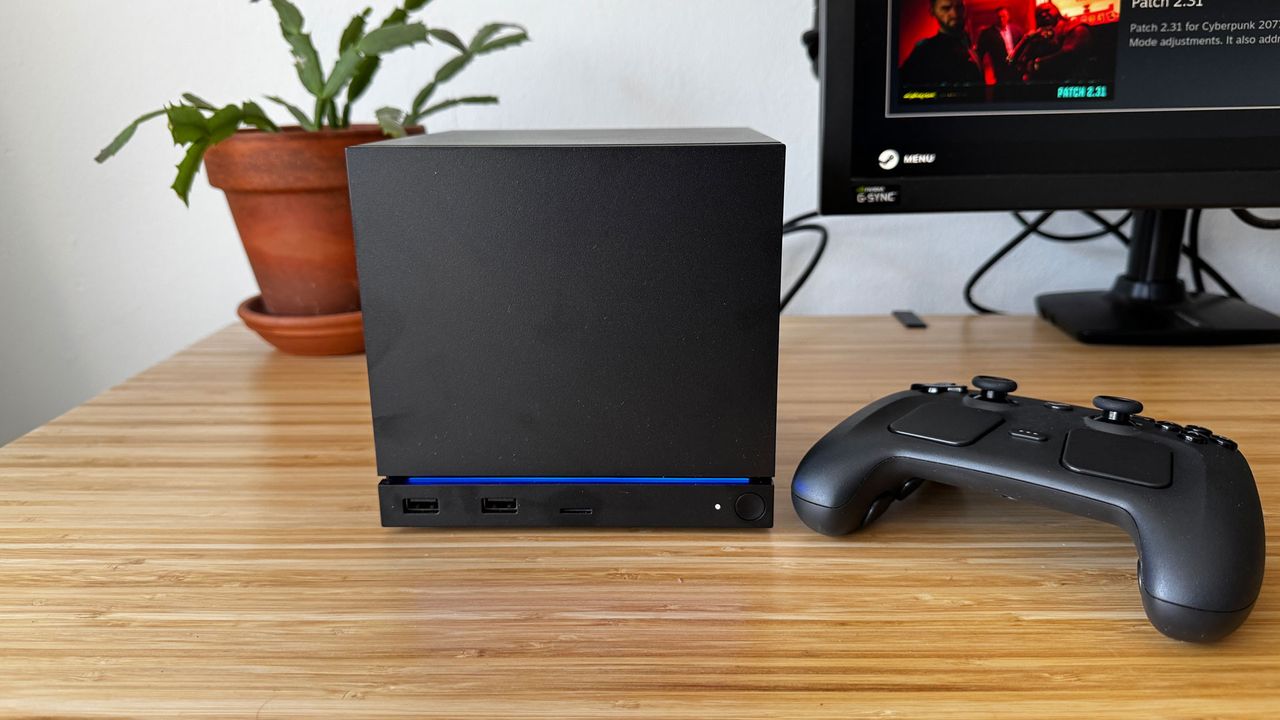
Valve’s Steam Machine is finally opening reservations, but the hardware’s launch arrives in a PC gaming landscape barely recognizable from the one that greeted its announcement. Global component shortages have pushed prices upward across the tech sector, sparking fierce debate about how much Valve’s new living-room PC would cost. After months of speculation, the company has revealed a starting price of $1,049—higher than many anticipated—but insists the system delivers value beyond raw specs.
A machine built for the living room, not subsidies
Valve’s engineers, Pierre-Loup Griffais and Yazan Aldehayyat, recently discussed the engineering choices behind the Steam Machine, including why it avoids the subsidy-heavy models common in console ecosystems. Unlike some portable gaming devices, Valve’s hardware is not propped up by revenue from its digital storefront. Instead, the company aims to keep pricing as close to the cost of parts as possible.
We understand that the higher price is less accessible to people… and so we're even more aggressive now, trying to be as close as possible to the actual cost of the parts that we're shipping.
Griffais explained that even during supply chain turbulence, Valve is prioritizing transparency over aggressive discounting. "It's not subsidized by software sales," Aldehayyat emphasized. "That’s a core principle."
Massive heatsinks and quiet operation: Engineering for the living room
Central to the Steam Machine’s design is its cooling system. The enclosure houses a semi-custom AMD RDNA3 GPU with 28 compute units, paired with a colossal heatsink that ensures whisper-quiet operation during marathon gaming sessions. Valve’s team chose this approach to eliminate the need for noisy fans while maintaining stable performance in a compact chassis.
During discussions, Griffais acknowledged concerns about the system’s 8GB of VRAM, a figure that has drawn scrutiny from enthusiasts. He argued that for most games playable on a TV in a small box, 8GB is sufficient—and that scenarios where VRAM bottlenecks occur are situations most users wouldn’t want to play anyway. Still, he conceded that future titles may demand more memory to hit similar performance levels.
Why the Steam Machine isn’t competing with consoles
Some observers have suggested that the $1,049 Steam Machine is priced out of reach when compared to consoles like the PlayStation 5 Pro at $899. Valve’s engineers reject that comparison outright. Instead, they frame the Steam Machine as a value proposition for PC gamers who already own a sizable Steam library.
The team highlighted features often overlooked in console comparisons: seamless integration with the Steam ecosystem, a dedicated Bluetooth controller antenna for low-latency input, and quiet operation ideal for shared living spaces. They also pointed out that PC gamers frequently repurchase titles across platforms or pay for online multiplayer—a cost that adds up over time.
The value of the Steam machine is inherently tied to the value of your Steam library… the more games you have on Steam, the more valuable the Steam Machine is.
Long-term viability in a slowing upgrade cycle
Aldehayyat noted that PC upgrade cycles have slowed dramatically in recent years. Modern games are increasingly optimized to scale across multiple hardware generations, reducing the pressure to replace components every few years. This trend aligns with Valve’s goal of building a system that remains relevant for years without frequent upgrades.
The engineers also confirmed ongoing work to optimize VRAM usage in SteamOS, including logic for discrete GPUs and improved memory management under load. While the current version of SteamOS was originally designed for APUs, Valve has adapted it to handle discrete graphics and VRAM more efficiently—key steps toward ensuring longevity.
As reservations open and the first units ship, Valve is betting that gamers who value flexibility, quiet operation, and deep ecosystem integration will see the Steam Machine as more than just a console alternative. Whether the high price proves accessible—or whether component costs continue to ease—remains to be seen. But one thing is clear: Valve is treating this hardware as a self-sustained program, not a loss leader.
AI summary
Valve’ın yeni Steam Makinesi’nin fiyatı neden yüksek? 8GB VRAM yeterli mi? Valve mühendisleriyle yapılan özel röportajda sistemin arkasındaki strateji ve geleceğe yönelik öngörüler.