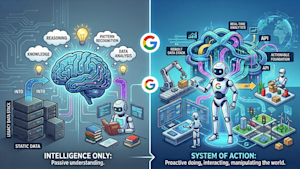
The rise of autonomous AI agents is exposing a critical flaw in enterprise data infrastructure: systems built for human-driven queries simply can’t keep pace with machines making decisions around the clock. Traditional data stacks, designed for scheduled reports and dashboard reviews, are breaking down as businesses demand real-time, actionable insights from their data. Google Cloud is addressing this gap with the Agentic Data Cloud, a newly announced architecture unveiled at Cloud Next, designed to transform how enterprises activate their data for AI-driven execution.
From reactive reporting to autonomous decision-making
For decades, enterprise data platforms have operated within a "system of intelligence" paradigm — where humans interpret data to make decisions, often after the fact. This reactive model, while familiar, fails to meet the demands of modern AI agents that require immediate access to accurate, contextualized data to act autonomously. Google Cloud’s new approach shifts the focus toward a "system of action," where data isn’t just observed but directly fuels AI-driven decisions.
Andi Gutmans, Vice President and General Manager of Google Cloud’s Data Cloud division, emphasized the urgency of this transition: "The data architecture has to change now. We're moving from human scale to agent scale." This shift isn’t merely about accessing more data; it’s about ensuring that data is not only accessible but also understandable and actionable for machines. Gutmans highlighted that this requires addressing both structured and unstructured data while maintaining trust — a challenge that goes beyond mere data access to include deep semantic understanding.
Automating context with the Knowledge Catalog
Traditional data catalogs have long relied on manual curation by data stewards, who label tables, define business terms, and build glossaries to make data interpretable. This labor-intensive process creates bottlenecks, especially as data estates grow exponentially. Google’s Knowledge Catalog, an evolution of its existing Dataplex product, automates this semantic layer by inferring business logic directly from query logs and usage patterns.
The practical implications for data engineering teams are substantial. Instead of maintaining curated subsets of data, the Knowledge Catalog scales to cover the entire data estate, including native support for Google Cloud services like BigQuery, Spanner, AlloyDB, and Cloud SQL. It also federates with third-party catalogs such as Collibra, Atlan, and Datahub, ensuring semantic consistency across hybrid environments. Zero-copy federation extends this semantic context to SaaS applications like SAP, Salesforce Data360, ServiceNow, and Workday without requiring data movement — a critical advantage for enterprises operating across multiple platforms.
Breaking cloud barriers with cross-cloud lakehouse capabilities
Google’s data lakehouse, BigLake, has evolved significantly since its launch in 2022. Initially confined to Google Cloud, BigLake now enables seamless querying of data stored in Amazon S3 through its new Cross-Cloud Interconnect, a private networking layer that eliminates egress fees. This architectural shift leverages the open Apache Iceberg format, allowing BigQuery to query Iceberg tables on AWS S3 with performance comparable to native AWS warehouses.
Gutmans explained the significance of this change: "This truly means we can bring all the goodness and all the AI capabilities to those third-party data sets." The cross-cloud lakehouse supports bidirectional federation with Databricks Unity Catalog, Snowflake Polaris, and AWS Glue Data Catalog, all using the open Iceberg REST Catalog standard. This means AI functions in BigQuery can operate on cross-cloud data without modification, ensuring consistency and reducing operational overhead.
Shifting from pipeline writing to intent-driven engineering
The final pillar of Google’s Agentic Data Cloud addresses the practical challenges faced by data engineers. Traditionally, building data pipelines has been a manual, prescriptive process — writing code to move data from source to destination, clean it, and transform it for downstream use. However, as Gutmans noted, "Customers are kind of sick of building their own pipelines. They're truly more in the review kind of mode, than they are in the writing the code mode."
The Data Agent Kit introduces a new paradigm: intent-driven engineering. Instead of writing Spark pipelines or SQL scripts, data engineers describe the desired outcome — such as a cleaned dataset ready for model training or a transformation enforcing governance rules — and the system selects the optimal execution method, whether it’s BigQuery, Apache Spark via the Lightning Engine, or Spanner. The kit integrates directly into popular IDEs like VS Code, Claude Code, and Gemini CLI, providing MCP tools and extensions that generate production-ready code automatically.
Differentiation in a crowded semantic layer market
Google’s approach isn’t entirely unique. Competitors like Databricks with Unity Catalog, Snowflake with Cortex, and Microsoft with Fabric’s semantic model layer are also investing in semantic governance and agent grounding. However, Google is positioning itself as an advocate for openness and interoperability.
Gutmans emphasized Google’s commitment to federating with third-party semantic models rather than requiring customers to rebuild their governance frameworks from scratch. This strategy contrasts with competitors who often prioritize proprietary ecosystems. Additionally, Google’s use of open standards like Apache Iceberg and the Iceberg REST Catalog standard further underscores its emphasis on flexibility and vendor neutrality.
The path forward for enterprise data stacks
The launch of Google’s Agentic Data Cloud signals a broader industry shift: data platforms must evolve from static repositories to dynamic, action-oriented systems capable of supporting autonomous AI agents. As enterprises increasingly rely on AI to drive business decisions, the ability to activate data in real time — without the friction of manual pipelines or siloed governance — will become a critical competitive advantage.
For data teams, this means moving beyond the constraints of traditional architectures and embracing systems that can scale with agent-driven demands. The question is no longer whether enterprises will adopt agentic data platforms, but how quickly they can transition from reactive reporting to proactive, autonomous execution.
AI summary
Google Cloud’s Agentic Data Cloud redefines enterprise data stacks for AI agents, replacing manual queries with autonomous systems that execute decisions in real time while reducing engineering overhead.
Tags