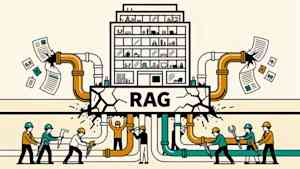
Enterprises are rapidly pivoting from traditional retrieval-augmented generation (RAG) architectures toward hybrid retrieval systems, according to fresh market data from VentureBeat’s Q1 2026 VB Pulse survey. Between January and March, the intent to adopt hybrid retrieval—combining dense vector embeddings, sparse keyword matching, and multi-stage reranking—tripled from 10.3% to 33.3%. This shift signals a fundamental reassessment of how production-grade AI systems retrieve and validate information.
The survey, which tracked responses from 45 to 58 qualified enterprise participants monthly, reveals a market caught between ambition and operational reality. While 22.2% of respondents reported having no production RAG systems by March—up from 8.6% in January—those with deployed systems are now prioritizing retrieval optimization over initial evaluation metrics. Steven Dickens, vice president at HyperFRAME Research, highlighted the growing strain on data teams: "Fragmented retrieval pipelines—spanning vector stores, graph databases, and relational systems—create a DevOps nightmare when scaling agentic workloads."
The architecture dilemma: Why hybrid retrieval is winning
The collapse of standalone vector databases as the default choice reflects a broader architectural reckoning. Platforms like Weaviate, Milvus, Pinecone, and Qdrant lost adoption share throughout the quarter, as enterprises consolidated around hybrid stacks or provider-native retrieval layers. The shift isn’t a rejection of vector databases entirely, but a recognition that single-method retrieval lacks the precision, access control, and scalability required for agentic applications.
Hybrid retrieval addresses these gaps by layering multiple retrieval techniques. Dense embeddings capture semantic similarity, while sparse keyword search preserves exact-match accuracy—critical for domains like patent litigation or legal research. Reranking layers then prioritize results based on relevance, confidence, and source credibility. "The vector database isn’t just a feature; it’s the ground truth," said Herbie Turner, CTO of &AI, whose platform processes hundreds of millions of patent documents with zero tolerance for hallucinated citations.
GlassDollar, a startup working with industrial giants like Siemens and Mahle, further illustrates the need for purpose-built retrieval. Its agentic system fans out a single user query into parallel searches across sub-corpora, combining results before reranking. "Recall is our north star," noted Kamen Kanev, GlassDollar’s head of product. "If the best matches aren’t surfaced, trust erodes instantly."
Reliability overtakes precision as the top priority
The criteria enterprises use to evaluate retrieval systems have undergone a dramatic shift. In January, 67.2% of respondents cited response correctness as the primary benchmark. By March, that metric had dropped to 41.9%, while operational reliability at scale surged to 31.1%—more than doubling and becoming the dominant concern. Access control and retrieval precision, once top priorities, now trail at 20.7% and 18.5%, respectively.
This pivot reflects the painful lessons learned from early RAG deployments. Systems optimized for document retrieval often fail when exposed to agentic workflows—where agents chain multiple queries, interact with tools, and require real-time validation. The standalone vector database, while precise, struggles under high query volumes and lacks built-in governance controls. Enterprises are now prioritizing stacks that can handle these demands without collapsing under operational overhead.
The road ahead: Consolidation and customization
The Q1 data paints a picture of an AI infrastructure market in active transition. While hybrid retrieval emerges as the consensus strategy, not all sectors are moving at the same pace. Healthcare, education, and government—where flat budgets are most common—show the highest rates of stalled or paused retrieval programs. Conversely, industries like legal tech and manufacturing are doubling down on purpose-built retrieval layers, driven by the need for auditability and recall.
Looking ahead, the trend points toward two parallel paths: consolidation and customization. Managed retrieval services are gaining ground as enterprises seek to reduce fragmentation, but a significant minority (35.6%) are building custom stacks—often combining both managed and self-hosted components. The message is clear: the era of one-size-fits-all RAG is over. Success will belong to those who can balance flexibility, reliability, and rigor at scale.
As Dickens noted, "The market isn’t rejecting retrieval—it’s rejecting the illusion that a single layer can do everything." For enterprises, the path forward requires rethinking retrieval not as a feature, but as the backbone of trustworthy agentic AI.
AI summary
Şirketler, bilgi geri çağırma altyapılarını yeniden yapılandırarak daha efektif ve güvenilir sistemler oluşturmak için çalışıyorlar.