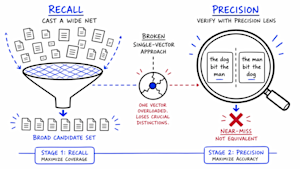
When enterprise teams tune their retrieval-augmented generation (RAG) embedding models to sharpen precision, they may unknowingly sabotage the very retrieval quality those pipelines rely on. A recent study from Redis exposes a critical tradeoff: training embedding models to excel at detecting subtle semantic differences—such as negation flips or word order changes—can quietly degrade broader retrieval performance, sometimes by as much as 40%.
The research, published in the paper Training for Compositional Sensitivity Reduces Dense Retrieval Generalization, highlights a fundamental tension in how modern embedding models learn. While fine-tuning can help models reject near-identical but meaningfully distinct sentences (e.g., "the dog bit the man" versus "the man bit the dog"), the same adjustments can undermine the model’s ability to generalize across unrelated topics or domains. Performance drops of 8–9% were observed in smaller models, while a mid-size production-grade embedding model saw a catastrophic 40% decline in retrieval accuracy.
Srijith Rajamohan, AI Research Leader at Redis and co-author of the study, emphasized that this finding challenges a long-held assumption about semantic search. "There’s a common belief that high semantic similarity guarantees correct intent," Rajamohan explained. "But that’s not always true. Two sentences can appear semantically similar yet convey entirely opposite meanings."
How fine-tuning rewires the embedding space
Embedding models compress entire sentences into high-dimensional vectors, positioning them in a geometric space where proximity reflects semantic similarity. This approach works well for broad topical matching—documents on similar subjects naturally cluster together. The problem arises when structurally distinct sentences with opposite meanings end up near one another because the model prioritizes lexical content over syntactic structure.
The research quantified this tradeoff. When teams fine-tune models to push apart sentences with flipped negations or reversed word orders, the model repurposes representational space that was previously dedicated to broad topical recall. The two objectives—precision and generalization—compete for the same vector space, leading to unintended consequences.
Curiously, not all failure types regress equally. Negation errors and spatial flips showed measurable improvement with structured training, while binding errors—where a model confuses which modifier applies to which word—remained largely unchanged. For enterprises, this means the precision problem is most stubborn precisely where the stakes are highest.
Why standard fixes fall short
Teams often default to well-known workarounds when retrieval precision falters, but the research found each approach fails in its own way.
- Hybrid search combines embedding-based retrieval with keyword search, a common practice in production systems. However, Rajamohan noted that this method doesn’t address structural near-misses. "If you compare the sentences ‘Rome is closer than Paris’ and ‘Paris is closer than Rome,’ keyword search won’t detect the difference because both contain the same words," he said.
- MaxSim reranking introduces a secondary scoring layer that compares individual query tokens against document tokens, a technique used in systems like ColBERT. While this improved relevance benchmark scores in testing, it failed entirely to reject structurally similar but meaningfully distinct sentences, assigning them artificially high similarity scores.
- Cross-encoders compare every word in the query against every word in the document, delivering high accuracy but at an impractical computational cost. Rajamohan’s team found that while these models perform well in controlled lab settings, they collapse under real-world query volumes.
- Contextual memory systems, often touted as the next evolution beyond RAG, still depend on retrieval at query time. Rajamohan cautioned that these architectures don’t eliminate structural retrieval problems; they merely relax latency constraints without addressing precision.
A two-stage solution emerges from the research
The study identified a two-stage approach that effectively mitigates the tradeoff without sacrificing generalization. The first stage involves training the embedding model to better distinguish structural nuances while preserving broad topical recall. The second stage introduces a lightweight reranker—such as a MaxSim-based model—that operates only on the top-k retrieved candidates, rather than the entire corpus.
This method balances precision and generalization by isolating the structural sensitivity task to a smaller subset of data, reducing the risk of degrading overall retrieval performance. The research validated this approach across multiple benchmarks, showing it could recover most of the lost accuracy without requiring a larger or more expensive model.
For enterprises building agentic AI pipelines—where retrieval errors can cascade into incorrect reasoning or actions—the findings underscore a critical lesson: precision tuning is not a one-size-fits-all solution. The geometry of embedding spaces imposes inherent tradeoffs, and teams must weigh improvements in specific failure modes against the risk of broader degradation. As Rajamohan put it, "You can’t scale your way out of this problem. More dimensions and parameters won’t fix the underlying architecture."
Looking ahead, the research suggests that future work in RAG optimization should prioritize modular, multi-stage architectures that decouple precision tuning from generalization. Until then, teams must tread carefully, testing every adjustment in production-like environments to ensure retrieval quality doesn’t come at an unforeseen cost.
AI summary
RAG modellerini hassasiyet için yeniden eğitmek, geri getirmede %40'a varan kayıplara yol açabilir. Araştırma, gizli tehlikeyi ve çözüm önerilerini ortaya koyuyor.