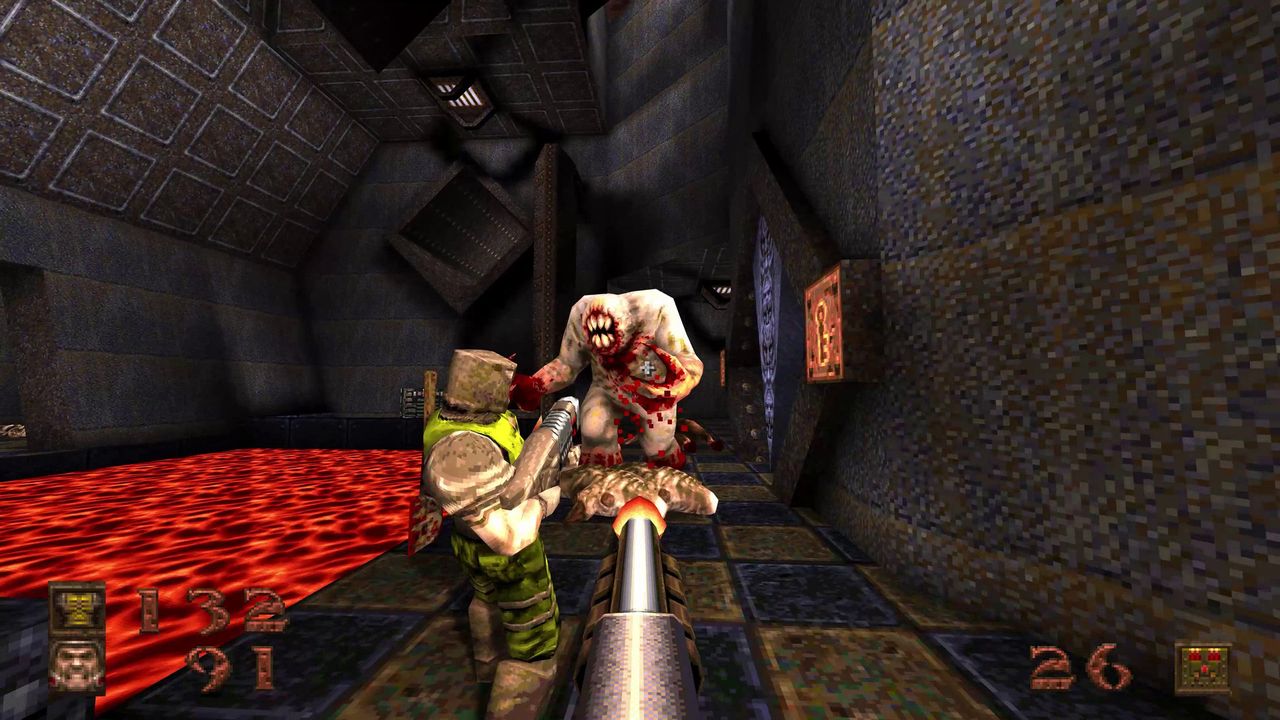
On June 22, 1996, id Software launched Quake, a first-person shooter that didn’t just push boundaries—it obliterated them. The game’s arrival didn’t just introduce a new title to the market; it redefined what players expected from PC gaming. With its groundbreaking 3D engine, Quake didn’t just enhance visuals—it fundamentally altered how games were designed, played, and even modified.
A 3D Revolution That Redefined Gaming
Before Quake, most first-person shooters relied on 2.5D techniques to simulate depth. Games like Doom and Duke Nukem 3D used clever tricks to create the illusion of 3D environments without true polygonal models. Quake, however, broke from tradition by delivering fully realized 3D worlds where every element—walls, characters, and objects—existed in three dimensions. This shift wasn’t just cosmetic; it introduced real 3D physics, collision detection, and movement mechanics that felt immersive in ways previously impossible.
The game’s technical achievements didn’t stop at visuals. Quake’s engine supported 360-degree vision and movement, allowing players to look up, down, and behind them—a feature that became a staple in later shooters. This innovation didn’t just improve gameplay; it set a new standard for what players would come to expect from 3D environments.
The Birth of Online Multiplayer Gaming
While Doom had popularized networked play with its deathmatch mode, Quake elevated online multiplayer to a new level. The game’s robust networking code and dedicated servers created a foundation for the competitive gaming culture that thrives today. Before Quake, online gaming was a niche experiment; after its release, it became a mainstream phenomenon.
The impact was immediate. Players no longer needed to be in the same room to compete—they could challenge opponents across the globe. This shift didn’t just change how games were played; it laid the groundwork for esports, streaming, and the digital gaming communities we know today. Developers like Valve’s founders first honed their skills in Quake’s competitive scene, proving that the game wasn’t just a technical marvel but a cultural catalyst.
From Mods to Machinima: A Legacy of Creativity
Quake’s influence extended far beyond its core gameplay. The game’s open architecture and modding tools unleashed a wave of creativity that reshaped the industry. Players and developers alike began crafting custom maps, total conversions, and entirely new game modes. Titles like Team Fortress and Quake Rally emerged from this community-driven innovation, proving that Quake wasn’t just a game—it was a platform for creativity.
The modding scene also gave rise to a new art form: machinima. By leveraging Quake’s 3D engine, creators produced short films and animations directly within the game’s environment. This early experimentation with in-game storytelling would later inspire tools and techniques used in modern game development and digital filmmaking.
The Hardware Catalyst: 3D Accelerators Enter the Scene
In the mid-1990s, PC gaming was dominated by titles that pushed the limits of available hardware. Quake’s true 3D engine, however, demanded more than what standard CPUs could deliver. Enter the 3D accelerator cards—add-in components designed to handle the complex rendering tasks that Quake introduced. These cards, including the 3dfx Voodoo, ATI Rage, and Nvidia Riva, became essential for gamers seeking smooth performance in Quake and later 3D titles.
The game’s QuakeGL version became a killer app for these hardware upgrades, driving sales and fueling the PC gaming hardware boom. Without Quake, the 3D accelerator market might have evolved more slowly—or not at all. The game’s technical demands inadvertently accelerated the development of graphics hardware, a legacy that continues to shape gaming today.
A Lasting Legacy in Code and Culture
Three decades after its release, Quake’s impact is still visible in modern gaming. The complete source code for Quake, along with its expansions like QuakeWorld and GLQuake, has been released under the GPL license, allowing developers to study, modify, and even repurpose it for new projects. This open approach has ensured that Quake’s innovations continue to inspire new generations of game creators.
From its groundbreaking 3D engine to its pioneering online multiplayer and modding culture, Quake didn’t just set a new benchmark—it redefined what a game could be. Its influence can be seen in everything from esports titles to indie game experiments, proving that true innovation isn’t just about flashy graphics or high scores; it’s about changing the way we play, create, and connect.
As the gaming industry continues to evolve, Quake remains a reminder of how a single game can shape an entire ecosystem. Its legacy isn’t just in the pixels on the screen but in the communities, technologies, and creative movements it inspired.
AI summary
Bugün Quake’in piyasaya sürülüşünün 30. yılı. Gerçek 3D grafikler, çevrimiçi çok oyunculu kültür ve donanım devriminin temellerini atan Quake’in oyun tarihine etkilerini keşfedin.