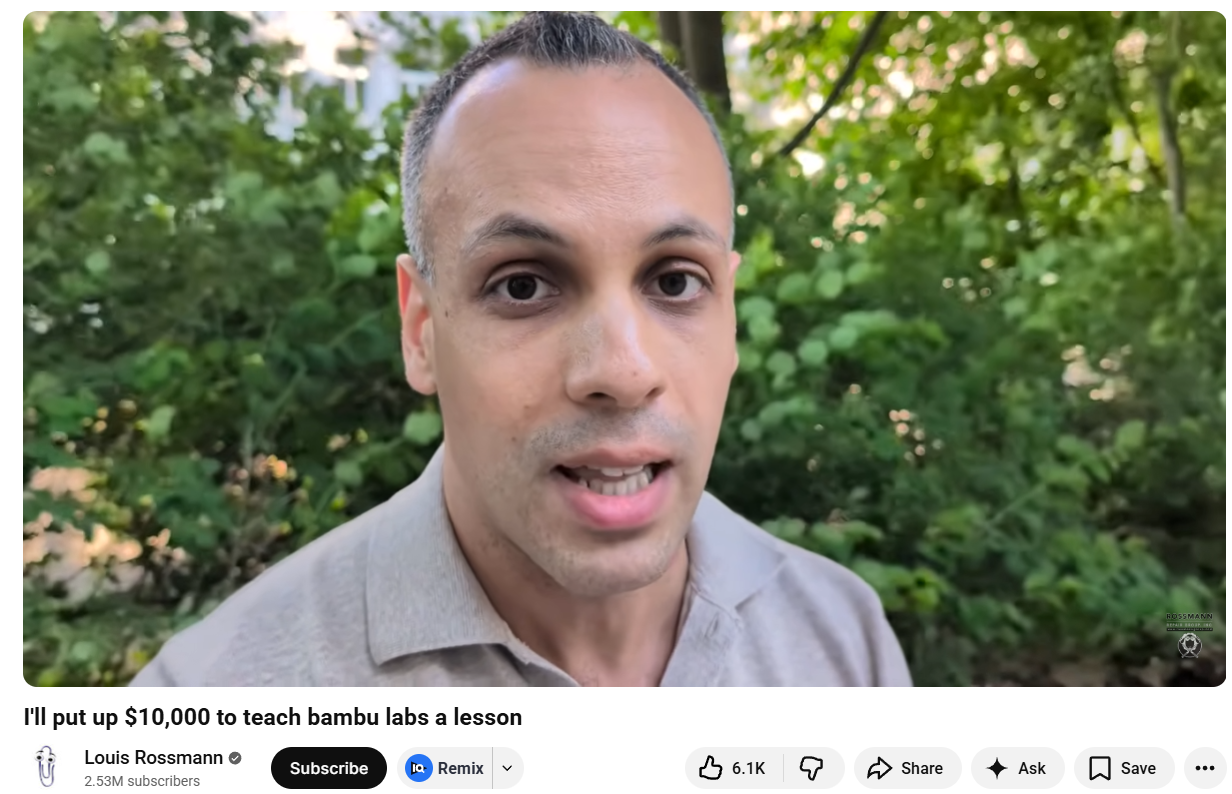
In a bold move to protect independent software innovation, Right to Repair advocate Louis Rossmann has pledged $10,000 to cover the legal fees for an OrcaSlicer developer facing a cease and desist letter from Bambu Lab. The announcement, delivered via a Saturday video, underscores Rossmann’s commitment to challenging corporate attempts to stifle third-party tools that empower users of 3D printers.
A developer caught in the crossfire of corporate legal pressure
Bambu Lab, a prominent manufacturer of 3D printers, has escalated its legal stance by targeting the creator of OrcaSlicer, an open-source slicing software widely used in the 3D printing community. The cease and desist letter alleges unauthorized use of proprietary protocols or unauthorized modifications to Bambu’s ecosystem, though the specifics remain undisclosed. The developer, who remains anonymous, has not publicly responded to the allegations but has received overwhelming support from users and advocates of free software.
Rossmann’s intervention arrives at a critical juncture. He framed the situation as an attack on the fundamental principle that users should retain control over the tools they purchase. "If you buy a printer, you should be able to modify, repair, or use any software you want without fear of legal repercussions," he argued in his video. His offer to cover legal costs is not just financial—it’s a rallying cry for the Right to Repair movement to stand against what he describes as monopolistic behavior in the 3D printing market.
The growing divide between manufacturers and the open-source community
This incident highlights a widening rift between hardware manufacturers and the open-source software community. Bambu Lab, known for its proprietary approach to printer firmware and ecosystem integration, has previously faced criticism for restricting third-party software compatibility. Industry observers note that such restrictions can limit user choice, stifle innovation, and create vendor lock-in, which undermines the collaborative ethos that has driven much of the 3D printing revolution.
OrcaSlicer, an open-source alternative to Bambu’s official slicing software, has gained a loyal following for its flexibility, performance, and compatibility with a wide range of 3D printers—not just those made by Bambu. Its developer community, which includes contributors from around the world, has emphasized transparency and user empowerment. The legal pressure against the project threatens to disrupt this collaborative environment and set a precedent for how manufacturers exert control over software ecosystems.
Legal and community responses to the threat
The cease and desist letter sent to the OrcaSlicer developer has sparked a wave of solidarity within the tech and 3D printing communities. Several crowdfunding campaigns have emerged, aiming to raise additional funds for legal defense and public awareness. Some advocates are calling for a coordinated effort to document and challenge Bambu Lab’s claims, while others are urging users to voice their support through petitions and social media campaigns.
Rossmann’s involvement has amplified the issue, drawing attention from broader tech circles. He emphasized that the legal fees, while substantial, are just the beginning. "This is about setting a precedent," he stated. "If Bambu Lab succeeds in shutting down OrcaSlicer, it sends a message to every independent developer that corporate power can override user rights." Legal experts suggest that the case could hinge on whether the software in question violates any patents, trademarks, or terms of service—areas where the specifics of Bambu’s claims remain unclear.
What’s next for OrcaSlicer and the Right to Repair movement
For now, the OrcaSlicer developer has not indicated whether they will comply with the cease and desist or pursue legal action. The community, however, is mobilizing. Donations to support the developer’s legal defense have already begun to flow in, and discussions about potential countermeasures are underway. Some suggest exploring legal avenues to challenge the validity of Bambu’s claims, while others are advocating for a unified stance in defense of open-source software.
This case also raises broader questions about the future of 3D printing. As the industry matures, manufacturers may increasingly seek to exert control over software and ecosystems to protect their intellectual property. Yet, the open-source community argues that innovation thrives when users have the freedom to experiment, modify, and share tools without corporate interference. The outcome of this dispute could shape the trajectory of the entire industry.
As the Right to Repair movement gains momentum, advocates like Rossmann are positioning themselves as guardians of user autonomy. The pledge to fund the OrcaSlicer developer’s defense is more than a financial contribution—it’s a declaration that the battle for control over technology is far from over.
AI summary
Sağlama hakkı savunucusu Louis Rossmann, Bambu Lab’in tehdit ettiği OrcaSlicer geliştiricisine 10 bin dolar destek teklifinde bulundu. Topluluk dayanışmasıyla hukuki savunma fonu oluşturuluyor.