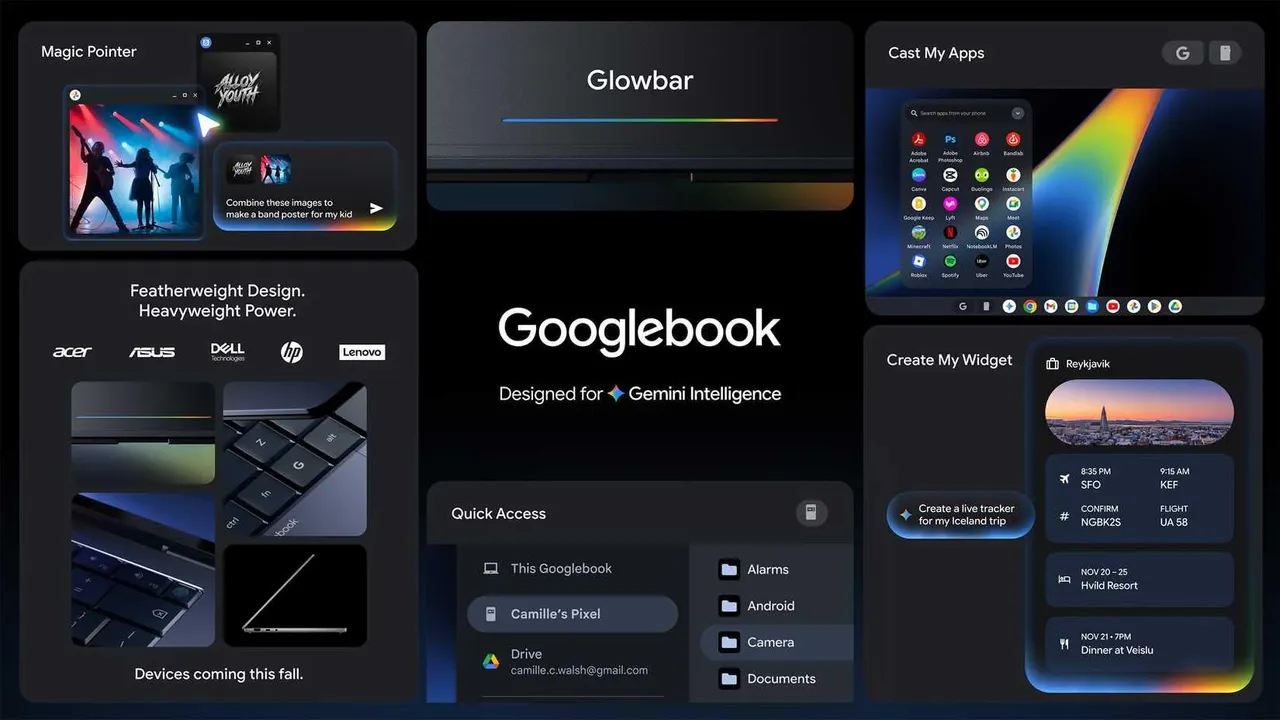
Google’s next-generation laptop platform, codenamed Googlebook, is poised to disrupt the Chromebook market with a design built around Android and deep integration with Google’s AI assistant, Gemini. Leaked details ahead of the official reveal suggest this platform will prioritize seamless connectivity with Android devices and introduce a dynamic Glowbar that adapts to user activity.
A platform designed for AI and Android
Unlike traditional Chromebooks, which rely on ChromeOS, Googlebook is engineered from the ground up to leverage Android’s flexibility and Gemini Intelligence. This shift means laptops under this platform will run a modified version of Android tailored for productivity, with native support for Google’s generative AI tools. Early reports indicate the system will allow users to sync files, apps, and notifications effortlessly across their Google ecosystem—smartphones, tablets, and even wearables—without manual setup.
The integration with Android isn’t just about software. Hardware components like cameras, microphones, and sensors are being optimized to work in tandem with Gemini, enabling features such as real-time transcription, context-aware app suggestions, and smart automation based on user habits. For example, a Googlebook could automatically switch to a presentation mode when connected to a projector, or dim the screen when detecting eye strain.
The Glowbar: A visual AI feedback loop
One of the most intriguing additions to the Googlebook platform is the Glowbar, a dynamic LED strip integrated into the laptop’s body. Unlike static indicators on traditional laptops, the Glowbar reacts to the device’s state and user interactions. According to leaked schematics, its colors and patterns could change based on:
- - Battery levels (green for high, amber for low)
- - Processing load (blue for idle, purple for heavy tasks)
- - AI activity (pulsing white when Gemini is generating responses)
- - Notifications (flashing red for urgent alerts)
While the Glowbar’s exact functionality remains unconfirmed, the idea suggests Google is experimenting with ambient computing—where the device subtly communicates its status without disrupting workflow. This aligns with the company’s broader push toward contextual computing, where laptops adapt to user needs proactively.
Why Googlebook could redefine the laptop market
Chromebooks have long been criticized for their limitations—restricted app ecosystems, offline functionality gaps, and a perceived lack of polish. Googlebook aims to address these pain points by combining the simplicity of ChromeOS with the power of Android and AI-driven enhancements. If successful, this platform could attract users who want a lightweight laptop that still offers deep software compatibility and intelligent features.
Industry analysts speculate that Googlebook laptops will launch with three tiers of hardware, targeting students, professionals, and power users. Rumored specs include:
- - Entry-level: 11-inch display, 8GB RAM, 128GB storage
- - Mid-range: 14-inch OLED, 16GB RAM, 256GB storage, AI NPU
- - Premium: 16-inch mini-LED, 32GB RAM, 1TB storage, advanced thermal design
The platform’s emphasis on AI and ecosystem integration also positions it as a competitor to Microsoft’s Copilot+ PCs and Apple’s M-series MacBooks, which already leverage on-device AI for tasks like photo editing and voice commands. However, Google’s advantage lies in its unified software ecosystem, where Android apps, Google Workspace, and Gemini can work in harmony.
What’s next for Googlebook?
While details remain scarce, the leaks suggest Google will unveil Googlebook at an upcoming Made by Google event, likely in late 2024. The company has yet to confirm pricing, exact release dates, or partner manufacturers, though ASUS, Lenovo, and Acer are rumored to be collaborating on hardware designs.
For now, enthusiasts and enterprise buyers will have to wait for official announcements. If Googlebook delivers on its promises, it could mark the beginning of a new era for laptops—one where AI isn’t just a feature but the foundation of the entire user experience. Until then, the tech community will closely watch how this platform evolves to challenge the dominance of traditional operating systems.
AI summary
Google’ın gizli kalmış yeni laptop platformu Googlebook tanıtılmaya hazır. Android tabanlı sistem, Chromebook’un yerini alacak ve Gemini entegrasyonuyla akıllı deneyim sunacak.