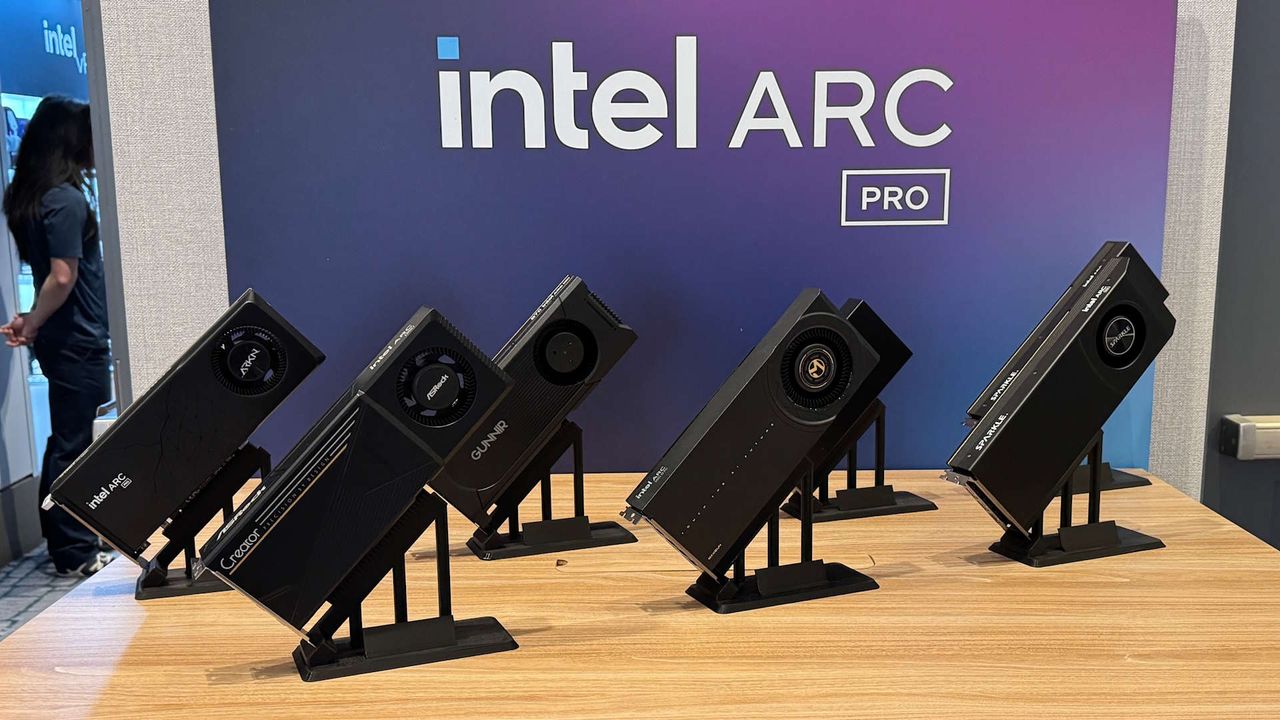
Intel’s latest addition to its professional graphics lineup, the Arc Pro B70, has entered the spotlight with promising early benchmarks. Designed for content creators and power users, this workstation GPU packs 32GB of VRAM and delivers competitive performance in both traditional and ray-traced gaming scenarios. Early testing suggests it bridges the gap between workstation reliability and high-end gaming capabilities, challenging expectations set by NVIDIA’s budget-oriented RTX 5060 Ti.
A Close Contest in Rasterization and Ray Tracing
In independent testing conducted at 1440p resolution, the Arc Pro B70 demonstrated strong performance across five popular titles. While it lagged slightly behind the RTX 5060 Ti 16GB in rasterized graphics—a common metric for raw gaming power—the gap narrowed significantly in ray-traced workloads. When averaging results across all tested games, the B70 closed the performance difference to just 2.9%, positioning itself as a viable alternative for users prioritizing ray tracing efficiency over sheer raster speed.
The Arc Pro B70’s architecture, optimized for professional workloads, appears to leverage Intel’s Xe-core design to balance compute and graphics tasks. Unlike consumer-focused GPUs, workstation cards like the B70 are engineered for stability under prolonged loads, making them ideal for video editing, 3D rendering, and AI-assisted applications. This dual-purpose capability sets it apart from NVIDIA’s RTX 5060 Ti, which remains primarily targeted at gamers.
VRAM Advantage: 32GB vs. 16GB
One of the Arc Pro B70’s standout features is its 32GB frame buffer, nearly double that of the RTX 5060 Ti. This capacity is particularly beneficial for professionals working with large datasets, high-resolution textures, or memory-intensive applications. While most modern games do not yet require more than 16GB of VRAM, the B70’s surplus memory future-proofs it for emerging workloads in AI, machine learning, and real-time ray tracing.
For creators, the additional VRAM translates to smoother multitasking and reduced latency when handling complex projects. The B70’s memory bandwidth, paired with Intel’s optimizations for content creation software, positions it as a compelling option for Adobe Premiere Pro, Blender, and Unreal Engine users who also dabble in gaming.
Power Efficiency and Thermal Considerations
Early thermal and power consumption data indicates the Arc Pro B70 operates within a reasonable envelope for a workstation-class GPU. While exact TDP figures vary by implementation, Intel’s focus on efficiency in the Arc series suggests the B70 will maintain lower operating temperatures than some of its predecessors. This is critical for workstations that demand consistent performance without thermal throttling.
The card’s power draw is also noteworthy when compared to NVIDIA’s RTX 5060 Ti. In rasterized tests, the RTX card typically consumes more power, particularly under synthetic benchmarks. The Arc Pro B70’s ability to deliver competitive ray tracing performance with potentially lower power demand could appeal to users conscious of energy costs or system stability.
Real-World Implications for Gamers and Creators
The benchmarks suggest the Arc Pro B70 is not merely a workstation-focused device but a versatile GPU that bridges gaming and professional needs. For gamers, the 32GB VRAM opens doors to modding, high-resolution texture packs, and experimental ray tracing settings without immediate hardware constraints. Meanwhile, creators gain a GPU that can handle both real-time previews and final render outputs without compromise.
However, software compatibility remains a consideration. While Intel has made strides in driver support, certain professional applications may still favor NVIDIA’s CUDA ecosystem. Users should evaluate their specific workflows to determine whether the Arc Pro B70’s advantages outweigh potential driver limitations.
Looking Ahead: A New Contender in the GPU Market
Intel’s Arc Pro B70 represents a bold step toward democratizing high-performance graphics for both gamers and professionals. By combining substantial VRAM, competitive ray tracing, and workstation-grade reliability, it challenges the traditional divide between gaming and professional GPUs. As driver support matures and more benchmarks emerge, the B70 could carve out a niche for users who refuse to compromise between power and versatility.
For those upgrading or building new systems, the Arc Pro B70’s performance metrics and memory capacity make it a strong candidate—especially for users invested in ray tracing or memory-intensive workflows. Whether it becomes a mainstream favorite remains to be seen, but its early results certainly justify a closer look.
AI summary
Intel’in yeni Arc Pro B70 grafik kartı, 32GB VRAM ve güçlü performansıyla oyunlarda nasıl bir sonuç elde etti? NVIDIA RTX 5060 Ti ile karşılaştırmalı performansı ve ışın izleme avantajı burada.