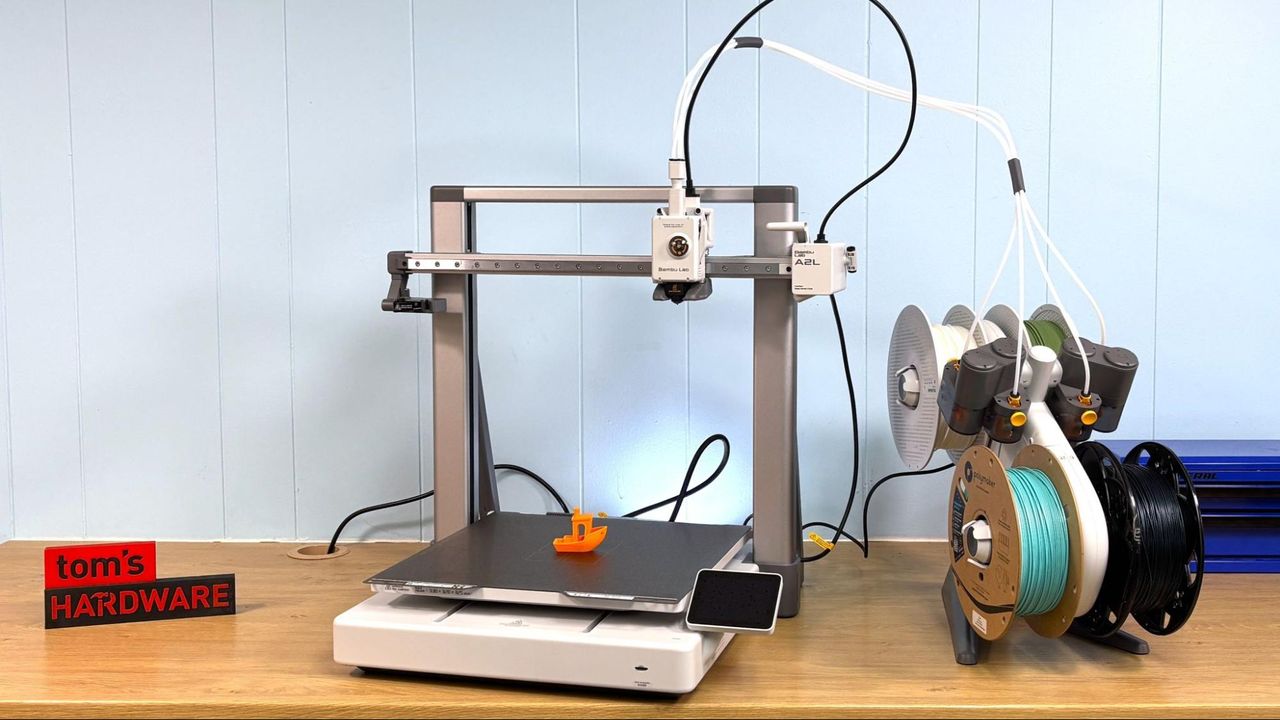
Bambu Lab has taken its popular A1 3D printer and scaled it up while keeping the simplicity that made the original so appealing. The new A2L model delivers a 330 x 320 x 325 mm build volume—matching Bambu’s more expensive H2 Series—while maintaining the plug-and-play experience that hobbyists and families expect. Priced at $469 for the standalone unit or $569 for a four-color combo, the A2L positions itself as an affordable entry into larger-format 3D printing without sacrificing speed or reliability.
A bigger footprint, same user-friendly DNA
The A2L’s build volume increases by over 60% compared to the original A1, making it suitable for bigger projects like multi-part prototypes or larger decorative prints. Despite its size, the printer retains the sleek white and brushed aluminum aesthetic that has become synonymous with Bambu Lab’s A-Series. The design remains uncluttered, with clean lines and a minimalist front panel housing a responsive 3.5-inch touchscreen.
Assembly is straightforward, requiring only a handful of screws and cable connections. The included cardboard toolkit contains all necessary tools, a test filament coil, and even a spare blade for customizing the included scraper. One notable omission is pre-applied lubrication on the Y-axis; Bambu Lab’s documentation explicitly recommends greasing the rails after initial setup to prevent premature wear.
Vibration challenges and Bambu’s unconventional fix
Larger 3D printers often face a trade-off between print speed and stability, but Bambu Lab has taken a bold approach to the A2L. Instead of throttling print speeds to dampen vibrations, the company filled the printer’s frame with granulated vibration-absorbing pellets. This allows the A2L to maintain the same high speeds as the A1 while keeping layer adhesion error-free.
However, this high-speed operation comes with a caveat: the printer’s stability depends heavily on the surface it rests on. During testing, the A2L’s AMS Lite module caused an IKEA Lack coffee table to slide off after 45 minutes of printing. Bambu Lab addresses this with a “steady” print profile that reduces vibrations at the cost of speed, and a “high-quality” profile that strikes a balance between performance and stability.
Material flexibility and smart filament handling
The A2L supports PLA, PETG, and TPU—three of the most popular filaments for hobbyists and educational use. The printer includes a PEI-coated spring steel bed that heats up to 100°C, with automatic bed leveling ensuring consistent first layers. For multi-color projects, the A2L pairs seamlessly with Bambu Lab’s AMS Lite, AMS, or AMS 2 Pro systems, which can dry filament on demand and read RFID tags from Bambu-branded spools.
Loading filament is a two-step process for single spools: push the filament through the Bowden tube to the toolhead, then initiate the load sequence via the touchscreen. The AMS systems automate this further, detecting filament type and color via RFID and drawing the material into the extruder with minimal user input.
Performance trade-offs and future considerations
The A2L’s vibration management system is its most polarizing feature. While it enables high-speed printing without quality loss, it also demands a sturdy surface—preferably a dedicated printer table or a reinforced desktop. For users on a budget, this might require an additional investment in stability solutions.
Bambu Lab’s decision to exclude an enclosure could limit material compatibility for advanced users, though the open-frame design remains ideal for PLA, PETG, and TPU. The company also introduced PLA Pure, a low-VOC filament designed for safer home printing, aligning with its push toward family-friendly crafting solutions.
With its blend of expanded capacity, smart automation, and Bambu Lab’s signature ease of use, the A2L carves out a clear niche in the mid-range 3D printer market. As the company continues refining its A-Series formula, the A2L stands as a compelling option for makers who need more space without adding complexity.
For now, the A2L’s success will hinge on how well users adapt to its vibration profile and surface requirements. But with a refined workflow and Bambu Lab’s track record of polish, it’s poised to become a go-to for hobbyists ready to step up from smaller printers.
AI summary
Bambu Lab A2L, geniş baskı hacmi ve dört renkli özellikleriyle aileler için ideal bir 3D yazıcı. Titreşim sorununa rağmen kullanım kolaylığı ve yüksek performansıyla öne çıkıyor.