Drug discovery remains one of the least efficient industries, with up to 95% of projects failing before reaching patients. Traditional pipelines force teams to pass fragments of knowledge between siloed groups, each introducing gaps that compound over years. Stanford University researchers are tackling this systemic inefficiency by deploying thousands of autonomous AI agents that replicate every phase of drug development—from initial molecular screening to regulatory submission—in a single, continuous workflow.
A team led by James Zou, associate professor of Biomedical Data Science at Stanford, has built what they describe as a virtual biotech lab where AI agents act as specialized scientists. These agents communicate through a hierarchical orchestration system, with a chief scientist officer agent overseeing delegation of tasks to domain-specific teams. One team focuses on drug discovery, another on safety evaluation, and additional groups manage clinical trial design and regulatory compliance—all while maintaining shared context throughout the process.
Zou explains that the system’s continuity stems from its unified architecture. Unlike traditional AI tools that operate in isolation, these agents retain the full history of a project, reducing knowledge loss during handoffs. "Each agent has access to the same contextual data, so decisions in early discovery directly inform later safety assessments and trial designs," Zou told VentureBeat ahead of his VB Transform 2026 session. This approach mirrors how a single pharmaceutical company might coordinate research, but with AI agents acting as tireless, specialized collaborators.
The backbone of the system relies on a vast, agent-friendly data infrastructure. Agents pull from genomics databases, FDA chemistry archives, clinical trial reports, and proprietary datasets, all channeled through what Zou calls a model context protocol. This protocol standardizes how raw enterprise data is transformed into formats AI agents can synthesize efficiently. The architecture combines multiple large language models, with Claude frequently handling coding and analytical tasks, while specialized models address niche requirements. Zou emphasizes that the system’s flexibility allows fine-tuning for specific applications without sacrificing coherence.
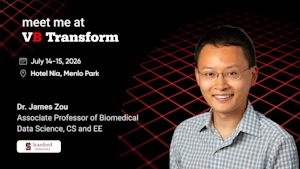
Behind the research lies a commercial venture: Human Intelligence, the startup Zou is building to scale these agentic systems. Reports indicate the company is raising funds at a $1 billion valuation, reflecting investor confidence in its potential to disrupt drug development timelines. During his VB Transform session on July 15, titled How 10,000 agentic scientists in Stanford’s lab are set to revolutionize medical research and discovery, Zou plans to detail strategies for managing long-running, multi-step workflows in multi-agent systems, transforming enterprise data into agent-native formats, and validating agent actions through human audits and experimental reward signals.
The implications extend beyond pharmaceuticals. Parallel discussions at the conference will explore how agentic AI can build trustworthy foundations in other sectors. For example, a session titled Building a trustworthy agentic AI foundation: How Zillow accelerated engineering by 40% will feature Toby Roberts, SVP of Engineering and Technology at Zillow, and Arvind Jain, CEO of Glean, sharing insights on engineering acceleration through agentic systems.
As drug discovery struggles with decades-long timelines and astronomical costs, Stanford’s agentic approach offers a radical departure from fragmented workflows. By integrating discovery, safety, and trials into a unified system, the research points toward a future where AI agents could dramatically reduce failure rates—and bring life-saving treatments to patients faster than ever before.
AI summary
Stanford araştırmacıları, 10.000 yapay zeka bilimci ajan kullanarak ilaç keşfi sürecini devrim niteliğinde değiştirmeyi hedefliyor. İşte detaylar ve VB Transform 2026'daki sunum.