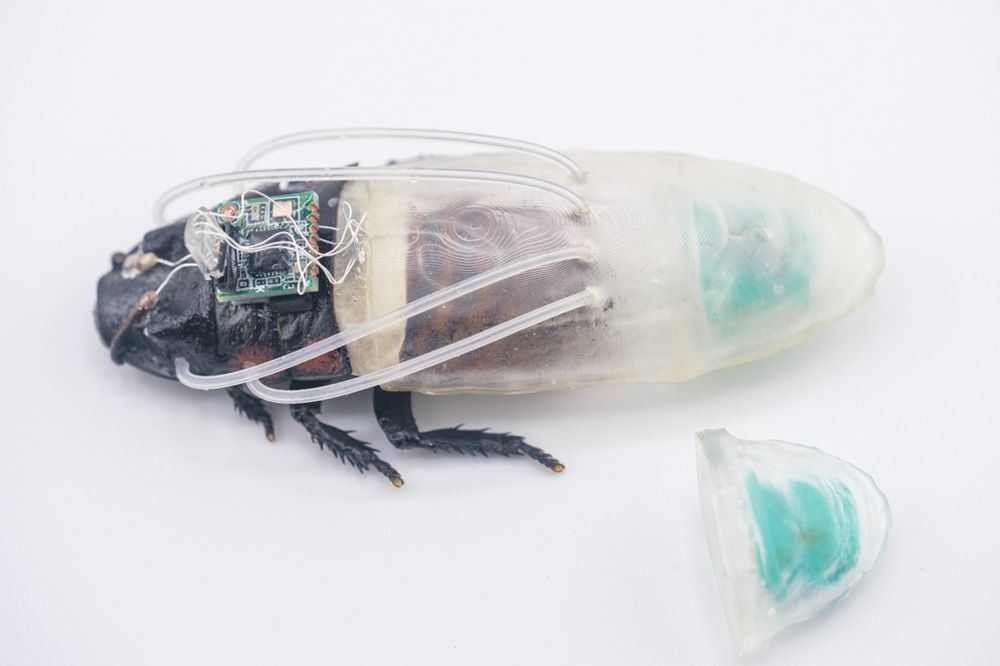
In a breakthrough blending biology and robotics, researchers at Nanyang Technological University have engineered a remote-controlled cyborg cockroach capable of surviving underwater for hours. The team, led by Hirotaka Sato, designed a lightweight 3D-printed "diving suit" that delivers oxygen to the insect through tubes connected to its spiracles, enabling it to navigate flooded environments without drowning.
From lab bench to disaster zones: The mission behind cyborg insects
The project builds on over two decades of research since DARPA’s HI-MEMS initiative, which explored hybrid insect systems for military and rescue applications. Sato’s team has refined their approach since demonstrating a swarm of remote-controlled roaches in 2024, addressing a critical limitation: the inability to operate in waterlogged areas where survivors might be trapped. Their latest iteration survived three hours submerged at depths up to 50 centimeters—sufficient for most puddles and shallow flood zones.
The roaches retain near-normal mobility underwater, moving at roughly 7.8 centimeters per second compared to 8.75 centimeters on land. While not true swimmers, their paddle-like leg movements allow them to navigate water with surprising efficiency. This adaptability makes them ideal candidates for search-and-rescue missions in disaster zones where traditional robots struggle to maneuver.
How the 3D-printed suit keeps roaches breathing
At the heart of the innovation is a compact oxygen-generating system integrated into the 3D-printed exoskeleton. Instead of bulky pressurized tanks, the suit uses a chemical reaction between hydrogen peroxide and manganese dioxide, releasing oxygen at a controlled rate. This design minimizes weight and complexity while ensuring the insects remain functional for extended periods.
The respiration system connects directly to the roach’s spiracles, the tiny openings it uses for breathing. By maintaining a steady oxygen supply, the suit prevents the insect from suffocating—even in turbid or contaminated water. The team calibrated the reaction to balance oxygen output with the roach’s metabolic needs, avoiding both over-oxygenation and depletion.
Why cockroaches are the perfect robotic platforms
Cockroaches possess a unique combination of traits that make them ideal for cyborg applications. Their segmented bodies and jointed legs respond precisely to electrical stimulation, allowing researchers to direct their movement with simple commands. Unlike many miniature robots, roaches can traverse nearly any terrain, from tight crevices to uneven surfaces, thanks to their robust exoskeletons and adaptive gait.
Biologically, the insects are nearly indestructible. They can survive without food for weeks, endure extreme temperatures, and even withstand radiation doses lethal to humans. Their resilience extends to respiratory challenges; they function in low-oxygen or high-carbon-dioxide environments and can hold their breath for up to 40 minutes by sealing their spiracles. These traits ensure longevity in harsh conditions—a critical advantage when deploying autonomous systems in real-world scenarios.
The team envisions deploying swarms of these submarine roaches in search-and-rescue operations, where their ability to infiltrate inaccessible areas could save lives. Beyond Earth, they’re eyeing extraterrestrial exploration, including potential missions to Mars. Given the roaches’ tolerance for radiation, temperature extremes, and even some toxic chemicals, such scenarios are no longer purely speculative.
The road ahead: From proof of concept to practical deployment
While the technology is promising, challenges remain before widespread adoption. Powering onboard cameras and wireless transmitters still requires miniature batteries, which add weight and limit mission duration. The team is exploring ways to integrate energy-harvesting systems or reduce power consumption further.
For now, the focus is on refining the design for real-world use. If successful, these cyborg roaches could complement traditional rescue methods, particularly in scenarios where human access is impossible. The line between biology and machine continues to blur, and with each advancement, the possibilities for hybrid systems grow more ambitious. Whether they become a staple in disaster response or a staple of science fiction remains to be seen—but their potential is undeniable.
AI summary
Singapur araştırmacıları, kızılötesi kameralı ve 3D baskılı dalış kıyafetiyle suya daldırılan robot hamamböceğini geliştirdi. Bu canlı robotlar, afet kurtarma ve Mars keşiflerinde devrim yaratabilir mi?