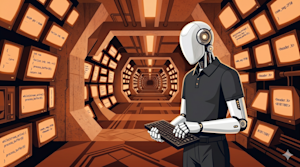
A team of researchers from UC Berkeley, Princeton University, EPFL, and Databricks has unveiled PixelRAG, a novel retrieval system that eliminates the error-prone text parsing step in enterprise AI pipelines. Instead of converting web pages into plain text—a process that destroys visual structure and contextual cues—PixelRAG renders pages as screenshots, indexes the images, and feeds relevant sections directly to a vision-language model (VLM).
In benchmarks covering 30 million screenshot tiles from Wikipedia, PixelRAG outperformed traditional text-based retrieval across six tasks, achieving up to 18.1% higher accuracy. The approach also slashes retrieval token costs by up to 10x, presenting a compelling case for enterprises seeking more reliable and cost-effective AI systems.
Why text parsers undermine AI accuracy
Traditional retrieval-augmented generation (RAG) systems rely on text parsers to convert web pages and documents into structured text before indexing. While this step seems logical, the researchers argue it introduces irreversible losses that compromise performance. "Improving parsers is an endless process because every website requires special handling," explained Yichuan Wang, lead author and UC Berkeley doctorate student. "Our goal was to explore whether recent advances in VLMs make it possible to bypass that entire problem and build a retrieval system that works across websites without site-specific engineering."
During HTML-to-text conversion, critical visual signals are lost: images, layout, typography, emphasis (such as bold text), tables, and hierarchical structures. These elements are either discarded or approximated inaccurately, degrading the quality of retrieved content. The researchers quantified the impact on a standard benchmark of 1,000 Wikipedia questions (SimpleQA):
- Parser loss (36.6% of failures): Structured content is destroyed, leaving no text chunk containing the answer.
- Rank loss (55.2% of failures): The answer exists but is buried under keyword-dense infoboxes, pushing relevant content to rank 20 or lower.
- Reader loss (8.2% of failures): The correct content reaches the model but misattribution occurs due to flattened structure.
How PixelRAG bypasses text parsing entirely
PixelRAG replaces the conventional text-based pipeline with a four-stage system that operates on rendered screenshots. The approach leverages modern VLMs, which can interpret both visual and textual information, mimicking human-like reading behavior.
- Rendering: Pages are rendered using Playwright at a fixed 875-pixel viewport and sliced into 1,024-pixel-tall tiles. Wikipedia’s 7 million articles produce about 30 million tiles, which are cached locally for offline processing.
- Indexing: Each tile is encoded as a 2,048-dimensional vector using Qwen3-VL-Embedding-2B and stored in a FAISS approximate nearest-neighbor index. The full index occupies approximately 120 GB in fp16 and supports incremental updates without full re-indexing.
- Training: The retrieval model is fine-tuned on synthetic contrastive data generated from the datastore, using dynamic hard-negative mining to eliminate false positives. LoRA, a parameter-efficient fine-tuning method, is applied to both the language model and visual encoder. Training on roughly 40,000 pairs completes in under three hours on a single H100 GPU.
- Storage: Raw screenshot tiles require 5.6 TB of storage, but PixelRAG employs a render-on-demand strategy. Screenshots are deleted after embedding, and pages are re-rendered at query time. The vector index, however, remains compact at 120 GB.
Benchmarks reveal 10x cost savings and higher accuracy
The research team evaluated PixelRAG across six benchmarks, including factual Wikipedia QA, table-based queries, multimodal QA, and live news retrieval. The system outperformed text-based RAG in all cases, even on tasks solvable from text alone. On SimpleQA, PixelRAG achieved 78.8% accuracy compared to 71.6% for the best text parser. For structured table queries, the gap widened to 48.8% versus 42.5%.
The cost advantage is particularly striking. In agent-based benchmarks, an AI system using PixelRAG processed 3.6 million prompt tokens versus 37.5 million for text retrieval, operating at 2 to 4 times lower cost than alternatives like Google while delivering higher accuracy. Further token reductions are possible with image compression.
However, challenges remain. PixelRAG currently slices pages by fixed pixel height, lacking the sophisticated visual chunking mechanisms that text-based systems have refined over years. This limitation highlights an area for future innovation as the field moves toward more visually aware retrieval systems.
AI summary
Yeni geliştirilen PixelRAG sistemi, web sayfalarını metne çevirmek yerine doğrudan ekran görüntüsü olarak işleyerek AI modellerinin doğruluğunu %18 artırıyor ve token maliyetlerini 10 kata kadar azaltıyor.