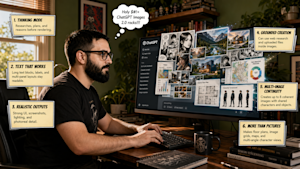
OpenAI has officially launched ChatGPT Images 2.0, a groundbreaking update that elevates AI-generated visuals to new heights. Unlike its predecessor, the new model introduces seamless multilingual text integration, full infographic construction, slides, maps, and even manga-style illustrations—all with remarkable precision. The rollout follows months of rigorous testing on platforms like LM Arena AI, where early users marveled at its ability to generate cohesive blocks of text, replicate real-world figures, and embed real-time web research directly into images.
What’s New in ChatGPT Images 2.0
The 2.0 update introduces several standout features that redefine generative AI’s role in visual content creation. Users can now generate detailed floor plans, multi-image grids, and character models from multiple angles with ease. The model also supports advanced text rendering in non-English languages, making it a versatile tool for global audiences. One of its most impressive capabilities is the ability to analyze uploaded files and synthesize them into polished visuals. For example, uploading a PowerPoint deck on product strategy might yield a professional poster that retains the original’s stylistic and structural elements.
For developers, OpenAI has launched the gpt-image-2 model via API, replacing the older GPT-Image-1.5, which will remain available for legacy use. OpenAI’s official notes emphasize a philosophical shift: "Images are a language, not decoration." This means the model doesn’t just generate random visuals—it selects, arranges, and reveals content purposefully, much like crafting a sentence.
Competing in a Crowded AI Image Space
The AI image generation landscape has become increasingly competitive, with Google’s Nano Banana 2 (also known as Gemini 3.1 Pro Image) entering the fray earlier this year. While both models excel at dense text integration, ChatGPT Images 2.0 stands out in replicating user interfaces, screenshots, and multi-image sets with exceptional fidelity. Early testing suggests its ability to generate historically accurate maps—such as those depicting the Aztec, Maya, and Inca empires at their peak—with fully legible legends, makes it a standout for educational and professional applications.
OpenAI’s model also introduces real-time web research integration, allowing it to pull in up-to-date data to ensure visual accuracy for current events or technical specifications. This "reasoning" capability sets it apart from traditional black-box image generators, which operate without contextual awareness.
Safety and Ethical Safeguards
With rising concerns over AI-generated misinformation, OpenAI has reinforced its commitment to ethical AI. The company now embeds metadata tags in every image to clearly indicate it was generated by AI. This move addresses growing reports—including one from The New York Times—of AI-generated personas being weaponized in political influence campaigns, such as fabricating "real Americans" to sway public opinion.
During a closed press briefing, Adele Li, OpenAI’s Product Lead for ChatGPT Images, stressed the company’s proactive stance on safety. "We take safety and security incredibly seriously, especially regarding political or election interference," Li stated. "While other platforms may lack these safeguards, ChatGPT enforces strict monitoring to protect users and prevent misuse of generated content."
The Future of AI-Generated Visuals
ChatGPT Images 2.0 marks a pivotal moment in AI visual generation, blending creativity with reasoning in ways previously unseen. Its ability to analyze, interpret, and synthesize complex data into coherent visuals positions it as a game-changer for industries like marketing, education, and design. As OpenAI phases out older models, the focus on advanced capabilities paired with robust safety measures sets a new standard for the industry.
Looking ahead, the integration of "Thinking" features and real-time research capabilities hints at a future where AI doesn’t just generate images—it understands context, validates accuracy, and adapts dynamically. For users, this means more reliable, versatile, and ethically sound visual content, reshaping how we interact with AI in creative and professional spaces.
AI summary
Discover ChatGPT Images 2.0’s breakthrough features: multilingual text, infographics, web-integrated visuals, and AI-generated posters. Learn how OpenAI redefines creative AI safely.
Tags