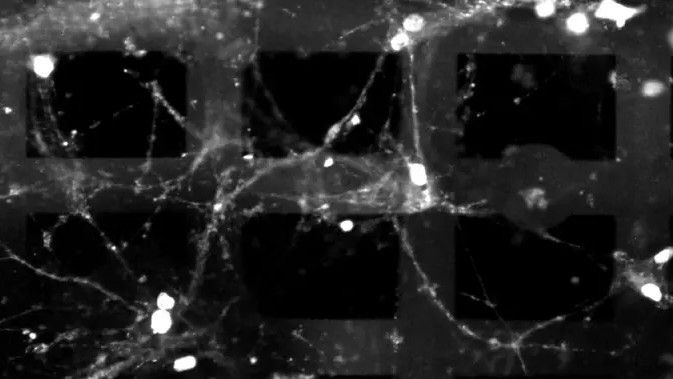
Researchers at Princeton University have achieved a major milestone in bioelectronics by creating a 3D device that integrates living brain cells with embedded circuitry. The hybrid system allows neurons—cultured outside the human body—to execute simple computational tasks, bridging the gap between biological and electronic processing. This innovation could reshape how scientists explore brain function, neurological disorders, and the inherent efficiency of neural computation.
A New Frontier in Bioelectronic Design
The device features a sophisticated 3D mesh structure that seamlessly combines electronic components with biological tissue. Unlike traditional rigid circuits, this design allows neurons to grow and connect naturally within the electronic framework. The mesh architecture ensures precise spatial alignment between the cells and electrodes, enabling reliable signal transmission. Early experiments demonstrate the system’s ability to perform basic logical operations, such as binary addition, using the neurons’ spontaneous electrical activity.
Why Living Neurons Outperform Silicon in Efficiency
One of the most compelling aspects of this technology is its potential to replicate the brain’s unparalleled energy efficiency. Biological neurons consume mere fractions of a watt while performing complex tasks, a stark contrast to silicon-based processors that require significant power for even simple calculations. The Princeton team’s device leverages this efficiency by using the neurons’ inherent adaptability and self-organizing capabilities. Researchers believe this approach could inspire energy-efficient computing architectures that mimic natural neural networks.
Applications in Neuroscience and Beyond
Beyond computational tasks, the 3D bioelectronic device serves as a powerful tool for neuroscience research. Scientists can use it to study how neurons process information, how disruptions in neural circuits contribute to diseases like Alzheimer’s or Parkinson’s, and how drugs affect brain function. The system also offers a platform for testing neural interfaces without invasive procedures on live subjects. Long-term, the technology could pave the way for biohybrid computers that combine the best of biological and electronic systems.
Challenges and the Path Forward
While the device represents a significant breakthrough, several hurdles remain before real-world applications become feasible. Maintaining neuron viability over extended periods is a primary concern, as biological cells degrade without proper nourishment and environmental control. Additionally, scaling the 3D mesh to accommodate larger neural networks presents engineering challenges. The Princeton team is now focused on optimizing the system’s stability and exploring ways to integrate it with conventional computing hardware. If successful, this work could redefine the boundaries of bioelectronic research and computing.
AI summary
Princeton araştırmacıları, canlı nöronlarla elektronikleri birleştiren 3D bioelektronik cihaz geliştirdi. Nörolojik hastalıklar ve beyin hesaplamalarını inceleme potansiyeli taşıyan bu yenilikçi teknoloji hakkında detaylar.