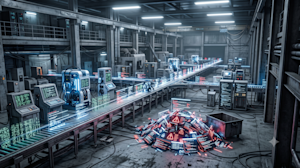
The promise of the software factory sounds irresistible: deliver more features, faster and cheaper, by treating code creation like an assembly line. After decades of relying on human developers and rigid CI/CD pipelines, artificial intelligence now seems to offer a shortcut to industrial-scale output. Yet the reality emerging in many organizations is less about progress and more about volume—more code churned out, but also more bugs, more confusion, and more technical debt.
This isn’t just a question of speed. It’s about how AI has fundamentally shifted the bottleneck in software development. Where once teams struggled to write enough code, now the challenge is deciding what to write—and ensuring that what is written is reliable, maintainable, and safe. Without the right guardrails, the software factory risks becoming a bug factory.
The rise of the AI-powered software factory
The concept of the software factory has gained traction over the past year, fueled by the belief that large language models (LLMs) can transform software development from a creative process into a repeatable production system. Influential voices like Luca Rossi, in his article "The Era of the Software Factory," have framed AI not just as a productivity tool, but as a catalyst for reimagining the entire software lifecycle.
But what does a software factory actually look like? Some envision it as a collection of AI coding agents, custom skills files, or automated review systems. Others see it as accelerated CI/CD pipelines or enhanced testing frameworks. The truth is more nuanced: a software factory is not a single tool or even a suite of tools. It is a platform—a unified system that defines how code is generated, reviewed, tested, deployed, and traced throughout its lifecycle.
Without this foundation, teams risk assembling a collection of prompts, agents, and plugins that operate in silos, with no shared context or standards. This fragmented approach may increase output, but it also introduces inconsistency, making code harder to maintain and debug. In other words, you’re not building a factory—you’re installing a single machine in an empty room.
Why the timing is critical—and risky
Several forces are converging to make the software factory idea both timely and dangerous. For years, companies have faced a persistent gap between the software they need and the engineers available to build it. Tools like spreadsheets and low-code platforms emerged to bridge this divide, but AI has now lowered the barrier to writing functional code to near zero.
Where once the bottleneck was writing code, it’s now often about deciding what to write. A single developer can now generate more code than ever before, but quantity doesn’t equal quality. The real question is whether that code contributes to durable, reliable systems—or just piles on technical debt at an industrial pace.
This shift also changes how we measure productivity. Traditional metrics like lines of code or pull request throughput now tell only part of the story. What matters more is whether the system remains stable, understandable, and maintainable as it scales. Recent data suggests that, in many cases, it isn’t.
The hidden costs of speed without structure
The allure of speed is undeniable. After all, factories made physical goods faster and cheaper, democratizing access to everything from cars to electronics. But engineering, whether physical or digital, always involves trade-offs. In software, those trade-offs are now playing out in real time.
When output scales without structure, mistakes scale too. Faros AI’s recent analysis found that while developer task throughput increased by 33.7% and pull request merge rates rose by 16.2%, the ratio of incidents to pull requests jumped by 242.7%, and bugs per developer increased by 54%. Google’s DORA research team reached a similar conclusion: greater AI adoption in software delivery was associated with worse stability in many cases.
These aren’t just numbers—they reflect real-world consequences. In my own work over the past year, I’ve encountered two data infrastructure projects where AI-generated systems slowly devolved into chaos. Multiple engineers working under pressure, combined with a lack of standards, led to codebases evolving into fragmented, unrecognizable sprawls. Within months, five or six distinct coding styles emerged—something that previously took years to develop. As the systems grew more complex, even the engineers who built them began to lose sight of how everything fit together.
This pattern echoes earlier mistakes with self-service tooling: early gains in productivity masked deeper, long-term costs. The software factory, if not built correctly, risks becoming a factory for technical debt.
What defines a successful software factory
To avoid falling into the same traps, teams must treat the software factory not as a toolset, but as a system—with clear principles, shared data, and traceable processes. Here are the core tenets that separate a true factory from a haphazard collection of AI tools.
Platform over tools
Many teams start by embedding AI into their workflows at the edges—adding a pull request review agent here, a skills file there. While these integrations can help, they don’t constitute a factory. A real software factory requires a platform: a unified foundation where tools are not scattered but interconnected. This platform must enable shared data, consistent standards, and seamless collaboration across teams. Without it, each AI component operates in isolation, leading to inconsistent output and increased complexity.
Rerunability and traceability
A true factory must allow teams to go back, diagnose issues, and rerun processes with precision. This is why one-off agents—no matter how advanced—fall short. The system needs to support stateful workflows: processes that can be paused, inspected, and restarted from any point. Tools like state machines, rather than loops, are better suited for AI workflows because they make it easier to trace how a result was produced and to reproduce it when needed.
Safety and standardization
Speed without safety is a recipe for disaster. A software factory must enforce standards—not just for code quality, but for how AI agents interact with systems, how data is handled, and how changes are reviewed. This includes clear ownership models, automated testing at every stage, and guardrails to prevent AI from generating unmaintainable or insecure code. Without these safeguards, the factory risks becoming a source of instability, not innovation.
Human oversight remains essential
Even in a highly automated environment, human judgment is irreplaceable. Teams must retain the ability to review, override, and refine AI-generated outputs. This means designing workflows where AI handles repetitive or low-risk tasks, but humans make the final decisions on architecture, security, and long-term maintainability.
The path forward: building responsibly
The software factory is not a distant vision—it’s already being built in organizations around the world. But its success will depend not on how fast it can churn out code, but on how well it balances speed with structure, automation with oversight, and innovation with reliability.
The companies that thrive will be those that treat AI not as a replacement for human developers, but as a force multiplier—one that amplifies the best of engineering while mitigating its risks. For the rest, the software factory may deliver features at record speed, but the bill will come due in the form of technical debt, instability, and lost trust.
The choice isn’t between speed and quality. It’s between building a factory that lasts—and one that collapses under its own weight.
AI summary
Yapay zeka destekli yazılım fabrikaları üretkenliği artırırken, teknik borç ve güvenilirlik risklerini de beraberinde getiriyor. Etkili bir sistem için nelere dikkat etmek gerekir?


