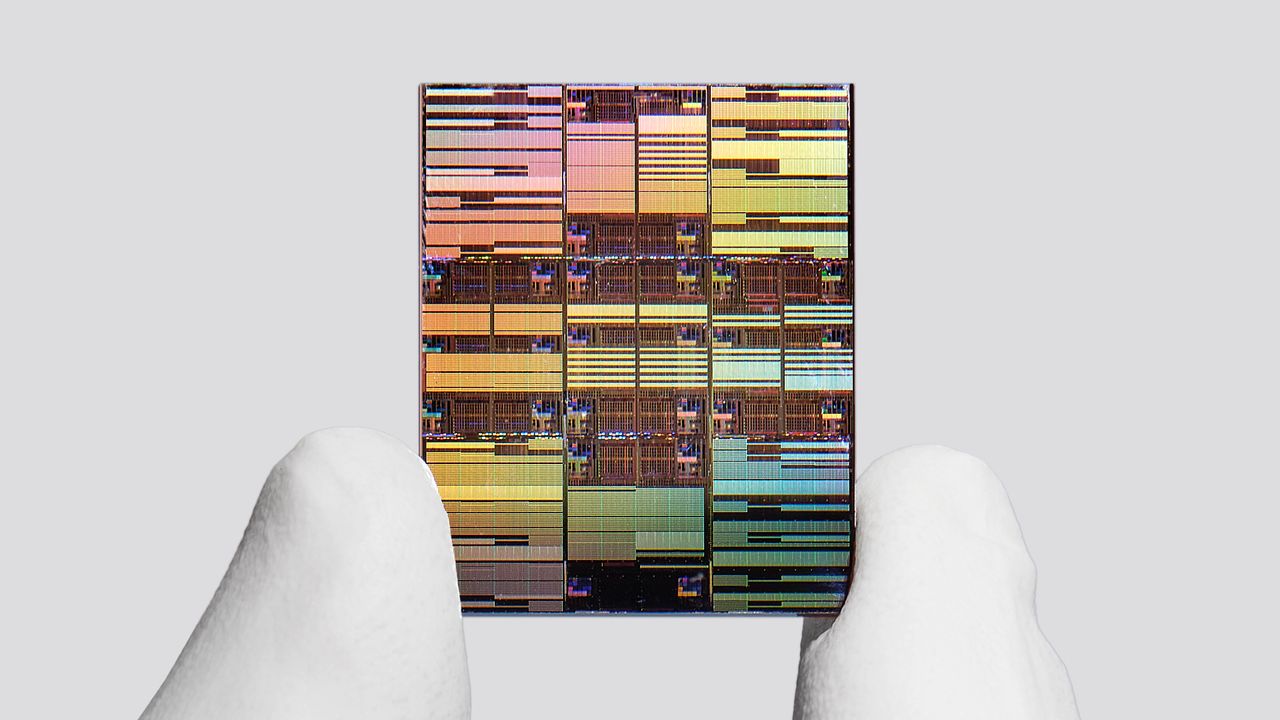
IBM has achieved a historic milestone in semiconductor innovation by demonstrating the world’s first sub-1nm chip technology. The breakthrough, developed at its Albany Research Lab, introduces a 0.7nm-class (7 angstroms) fabrication process that delivers up to 50% higher performance and 70% greater energy efficiency compared to its 2nm-class nanosheet technology introduced in 2021. This advancement not only pushes the boundaries of Moore’s Law but also signals a potential shift in how future processors are designed for AI workloads and high-performance computing.
A paradigm shift in transistor architecture
At the core of IBM’s innovation lies the nanostack transistor—a radical departure from traditional monolithic transistor layouts. Unlike conventional designs where n-type and p-type transistors sit side by side in a single layer, IBM’s nanostack separates these components into vertically bonded tiers. This 3D stacking effectively transforms a 2D CMOS pair into a compact 3D structure, reducing lateral footprint and doubling transistor density without relying on planar shrinks.
The architecture leverages ultra-thin dielectric bonding to integrate the two wafers, enabling independent optimization of n-type and p-type channels. For the first time, IBM can tailor materials, strain engineering, and geometries separately for each transistor type—something impossible in single-tier processes. This flexibility could unlock new performance ceilings, particularly for AI accelerators and data center chips where power efficiency and density are critical.
Performance gains and trade-offs
According to IBM’s benchmarks, the 0.7nm-class process delivers several key advantages over its predecessor:
- Up to 50% higher performance in logic operations
- 70% reduction in power consumption
- 40% improvement in SRAM density
- Higher density gains for logic transistors
These gains are made possible through a combination of material innovations and structural enhancements. However, the approach introduces significant manufacturing challenges. Aligning and bonding two advanced wafers with nanometer precision is no small feat. Any misalignment or defect at the bond interface could compromise yield, while routing and power delivery become exponentially more complex in a dual-tier system. Cooling also presents a hurdle, as the upper tier sits farther from heat dissipation pathways.
Cost is another major consideration. IBM must absorb the expense of producing two full-wafer logic tiers, additional bonding steps, and process complexity—all of which could drive up production costs. The company has not disclosed cost estimates or long-term manufacturability assessments. Its current test chip, roughly the size of a fingernail, serves as a proof of concept rather than a production-ready solution.
Niche applications, not mainstream chips
IBM suggests its 0.7nm technology is best suited for high-performance, high-power applications—particularly AI accelerators and data center processors. These chips often occupy nearly the full reticle size, making them prime candidates for the density and efficiency gains offered by nanostack transistors.
Mainstream consumer chips, however, may not benefit as directly. Alternative approaches like monolithic CFETs (complementary field-effect transistors) could achieve similar density improvements without the complexity of dual-wafer integration. IBM acknowledges this, implying that its technology complements rather than replaces existing methods.
Interestingly, IBM’s breakthrough does not rely on next-generation High-NA EUV lithography—tools IBM lacks in its Albany facility. Instead, it uses proven Low-NA EUV systems, which simplify yield management. The company hints that future nodes may incorporate High-NA tools, though field stitching challenges could complicate the transition.
The road ahead: feasibility and adoption
IBM describes its 0.7nm process as part of a broader research initiative, not an immediately licensable fabrication technology. Unlike commercial nodes, this achievement represents pre-competitive intellectual property designed to inspire industry collaboration. Real-world deployment within the next five years remains uncertain, as scaling and yield optimization will take time.
Still, the implications are profound. If successfully industrialized, sub-1nm technology could redefine the economics of AI hardware, enabling more powerful and energy-efficient chips for data centers, supercomputing, and edge devices. For now, IBM’s announcement serves as both a technical triumph and a reminder of the challenges that lie ahead in the relentless pursuit of smaller, smarter, and more efficient semiconductors.
AI summary
IBM, 0,7 nanometre sınıfı çip teknolojisini duyurdu. Performansı %50 artırırken, enerji tüketimini %70 düşüren nanostack transistörler, yarı iletken endüstrisinde devrim yaratabilir.