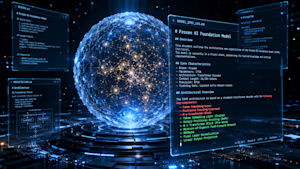
In most AI systems today, text generation works like a typewriter: one token at a time, left to right, with no chance to revise once a token is committed. This approach is efficient in the cloud, where batch processing keeps GPUs busy, but it wastes compute in local or low-concurrency settings where GPUs sit idle. Google’s new DiffusionGemma model breaks that pattern by applying a diffusion-based approach to text generation—one typically used in image models like Stable Diffusion—and delivers measurable speed improvements at scale.
Released under the Apache 2.0 license and built on the Gemma 4 backbone, DiffusionGemma is the first diffusion-based language model integrated into the open-source vLLM inference platform. Unlike autoregressive models, it generates a full 256-token block in parallel, allowing every token position to attend to every other. According to vLLM benchmarks, the FP8 version achieves up to 1,008 tokens per second on a single Nvidia H100 and up to 1,288 tokens per second on an H200—roughly five to six times faster than standard autoregressive baselines under ideal conditions. While Google emphasizes performance gains, the company also notes that output quality is lower than standard Gemma 4, recommending it for applications where speed outweighs absolute perfection.
How DiffusionGemma redefines text generation
DiffusionGemma does not build text sequentially. Instead, it begins with 256 random placeholder tokens—like a blank canvas—and refines the entire block in parallel through multiple passes. During each pass, the model evaluates every token position and locks in the most confident ones. Positions with low confidence are re-randomized and reconsidered in the next pass, using previously resolved parts of the text as context. This iterative refinement continues until enough tokens stabilize to anchor the rest of the output.
This architecture enables two key capabilities. First, self-correction: unlike autoregressive models, which are locked into early errors, DiffusionGemma can revisit uncertain tokens and revise them in later passes. Second, bidirectional context: because all tokens attend to each other simultaneously, the model sees the full context from the start, making it especially effective for tasks where order matters, such as constrained generation or structured reasoning.
Google demonstrated these advantages with a fine-tuned Sudoku solver. The base model solved zero puzzles, but after training on Sudoku datasets, it achieved an 80% success rate and converged in just 12 denoising steps—far fewer than the 48 typically needed. The efficiency gain came directly from the model’s ability to correct mistakes and halt early when the solution stabilizes.
The technical foundation behind the speed
DiffusionGemma is a 26-billion-parameter Mixture of Experts model, but only 3.8 billion parameters are active during inference. When quantized, it fits within 18GB of VRAM, enabling deployment on consumer GPUs like the Nvidia RTX 4090 and 5090. Google and NVIDIA also optimized the model for enterprise-grade servers using Hopper and Blackwell architectures with NVFP4 kernels.
Integrating DiffusionGemma into vLLM required architectural changes, because it does not follow the standard serving pattern. Traditional vLLM batches apply the same attention mechanism across all requests, but DiffusionGemma alternates between causal and bidirectional attention as it processes prompts, refines the token block, and commits the final output. To support this, the team developed a per-request attention switching mechanism for both the Triton and FlashAttention 4 backends, reusing the existing speculative decoding path for the refinement loop. They also introduced a new ModelState interface designed to make it easier to integrate future diffusion models into vLLM.
When DiffusionGemma speeds things up—and when it doesn’t
Despite the headline numbers, DiffusionGemma’s speed advantage is highly context-dependent. Its performance gains are most pronounced under specific conditions.
- Where it wins: Local inference, single-user applications, and low-concurrency deployments. In these scenarios, GPUs often have idle compute cycles, and memory bandwidth becomes the bottleneck. DiffusionGemma’s parallel block generation fills that gap efficiently.
- Where it doesn’t: High-throughput cloud serving with hundreds of concurrent users. Under heavy load, autoregressive models already saturate available compute, and DiffusionGemma’s parallel decoding offers limited additional benefit.
- The quality trade-off: As AI researcher Guilherme O’Tina noted, “Local artifacts versus hallucinations are different problems, and that decides where this actually wins.” DiffusionGemma prioritizes speed over perfection, making it suitable for use cases where latency is critical but absolute accuracy can be relaxed.
How it stacks up against prior art
Diffusion-based text generation is not new. Researchers have experimented with smaller-scale models for years, and Inception Labs’ Mercury Coder applied a similar approach commercially to code generation in 2025. What sets DiffusionGemma apart is its scale: a 26B MoE backbone, native vLLM integration, and a general-purpose instruction-tuned model rather than a domain-specific tool.
While autoregressive models remain the default for most applications, DiffusionGemma signals a shift toward hybrid architectures that blend speed with flexibility. For developers building interactive or latency-sensitive tools, it offers a compelling alternative—provided the quality trade-offs align with their use case. The model’s open-source release and vLLM support lower the barrier to experimentation, making it easier to evaluate whether diffusion-based generation fits specific workflows.
As AI workloads diversify, models like DiffusionGemma could redefine how we think about text generation—not just as a sequence of tokens, but as a dynamic, self-correcting process that adapts in real time.
AI summary
Google'ın yeni DiffusionGemma modeli, metin üretimini geleneksel yöntemlere göre 4 kata kadar hızlandırmayı başaran bir teknoloji sunuyor. İşte bu yenilikçi yaklaşımın nasıl çalıştığı ve hangi durumlarda devreye girdiği.