Dun & Bradstreet’s Commercial Graph has tracked 642 million companies and their interconnections for over a century, serving credit analysts, risk teams, and sales teams with data curated for human decision-making. But as enterprises began embedding AI agents into workflows such as credit scoring, procurement, and supply chain risk assessment, the decades-old system revealed critical limitations: it could not deliver the sub-second responses, real-time relationship updates, or unambiguous entity matching required by machines.
Gary Kotovets, Chief Data and Analytics Officer at Dun & Bradstreet, described the challenge plainly. "We need to think about agents as our new consumer category," he told VentureBeat. "Beyond traditional credit analysts or sales professionals, we now have to cater to these customers’ AI agents as primary users."
The gap between human and machine data access
The Commercial Graph wasn’t a single database but a patchwork of regional systems, custom integrations, and legacy architectures designed for SQL queries and human interfaces. AI agents, by contrast, demand standardized, machine-readable data with near-instant latency. The scale of the problem became evident in just five years: the database doubled from 300 million to 642 million business records, each with up to 11,000 fields. At current volumes, Dun & Bradstreet runs approximately 100 billion data quality checks monthly—operations ill-suited for fragmented architectures.
Static relationship models compounded the issue. Legacy systems tracked fixed links—such as a CEO to a company—without recording how relationships evolve. When a CEO changes roles, agents assessing credit risk or third-party compliance need to know which company retains their track record. Similarly, when a subsidiary changes ownership, the corporate hierarchy must update dynamically. Such reasoning requires real-time contextual reasoning that human analysts could handle manually, but machines cannot afford to wait.
A unified foundation built for agents
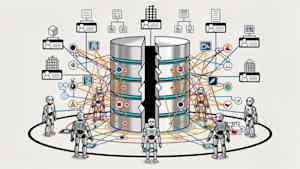
Dun & Bradstreet responded with a full rebuild. First, it consolidated fragmented databases onto cloud infrastructure, redesigned the underlying schema, and implemented a data fabric layer to normalize records across global markets while ensuring regional regulatory compliance. The result is a unified knowledge graph that tracks billions of dynamic relationships across all 642 million companies, continuously updated and enriched using AI-driven processing.
Next, the company developed a structured access layer tailored for AI agents. Raw SQL access proved too slow and brittle at agent query volumes. Instead, Dun & Bradstreet introduced a set of tools and skills via the Model Context Protocol (MCP), which packages data with relevant context and routes agents to verified records. A dedicated match and entity resolution engine sits behind every query, ensuring that when an agent asks for information about a company, it receives a precise, verified entity—not a fuzzy name match.
Identity, security, and workflow coherence for AI agents
Rebuilding the graph and adding MCP access addressed data retrieval but not agent identity. Dun & Bradstreet’s legacy authentication model, built for human users, couldn’t extend to machines. The company introduced a new registration model where agents must verify their IP address and present an access key treated as a machine identity within the same security pipeline as human users.
"We have a concept of Know Your Agent, analogous to Know Your Customer, which performs additional verifications," Kotovets explained.
This solves the inbound challenge: authenticating which company owns the agent and which data it’s permitted to query. But Dun & Bradstreet also tackled the outbound problem—ensuring that agents in a multi-step workflow remain aligned on the same entity even when they operate independently.
Consider a credit check agent, a KYC agent, and a third-party risk agent operating in sequence. Without a mechanism to confirm they’re analyzing the same company, the workflow could complete using inconsistent records. To prevent this, Dun & Bradstreet introduced a verification agent embedded into any workflow as a persistent reference point. This agent is accessible via Google’s A2A protocol regardless of the orchestration tool in use, effectively acting as a "digital handshake" that aligns agents throughout the process.
Four principles for enterprises building AI agent systems
Dun & Bradstreet’s rebuild offers lessons beyond its own technology stack. Based on conversations with hundreds of Chief Data Officers and Chief Information Officers over the past year, Kotovets identified four prerequisites for enterprises deploying AI agents at scale:
- Clean, normalized data comes first. Most organizations hit a wall not because of agent technology, but because their data remains fragmented, duplicated, or unstandardized. Without a unified foundation, AI initiatives stall regardless of the tools used.
- Model relationships as dynamic, not static. Enterprise systems often store point-in-time connections—such as a person to a company or an asset to a subsidiary. AI agents require continuous reasoning over shifting relationships, which demands updated schema design and real-time updates.
- Prioritize machine-readable interfaces over human tools. APIs, MCP services, and structured query layers designed for agents outperform traditional SQL endpoints and dashboard integrations.
- Implement agent identity and provenance early. Authentication, access control, and workflow coherence must be built into the architecture from day one, not retrofitted later.
As AI agents permeate enterprise operations, the companies that succeed will be those that treat their data infrastructure not as a static asset, but as a living system capable of serving both humans and machines with precision, speed, and trust. Dun & Bradstreet’s journey shows that even a 180-year-old data pioneer must evolve—or risk becoming obsolete in the age of intelligent automation.
AI summary
Dun & Bradstreet, 642 milyon işletmeyi kapsayan Commercial Graph veritabanını AI ajanlarının ihtiyaçlarına göre yeniden tasarladı. Veri bütünlüğü, dinamik ilişkiler ve ajan kimlik yönetimi nasıl sağlandı?