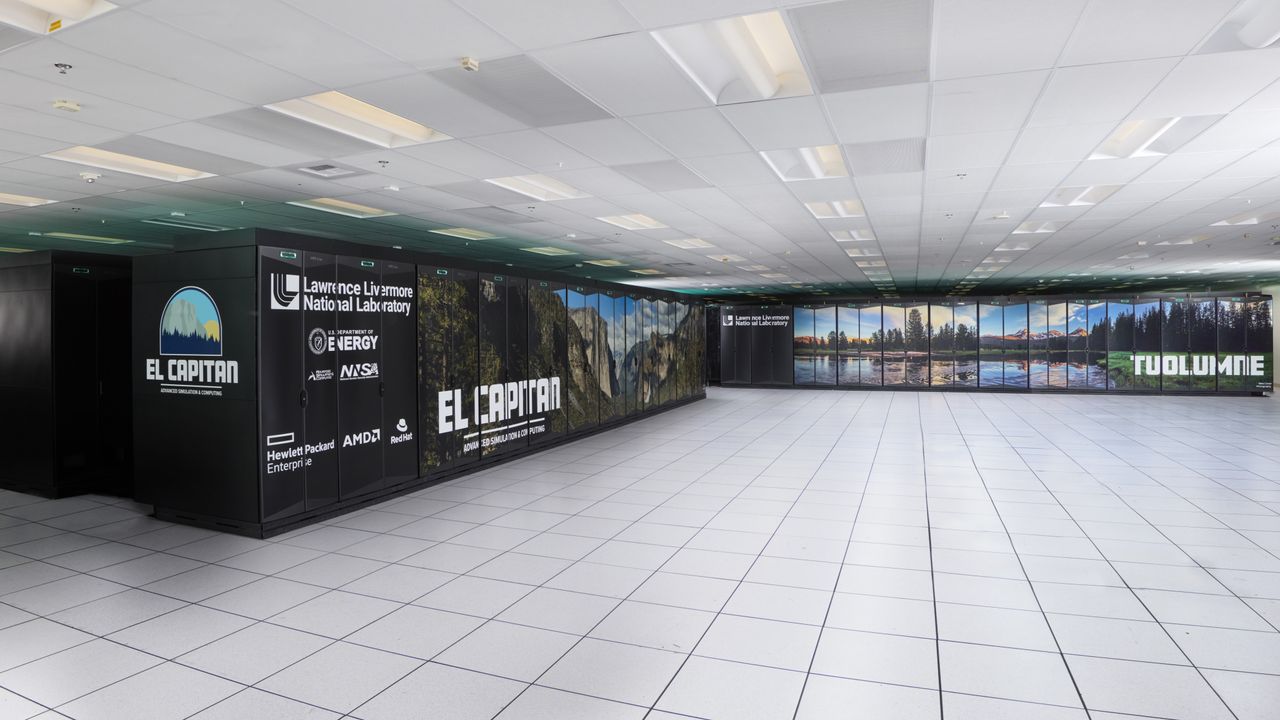
China has officially overtaken the United States in high-performance computing with the debut of LineShine, the world’s first supercomputer to sustain over two exaflops of double-precision performance using only CPUs. The system achieved 2.198 exaflops on the High Performance Linpack benchmark, pushing the AMD-powered El Capitan into second place with a performance gap exceeding 20%. Installed at the National Supercomputing Centre in Shenzhen (NSCS) and built by the Shenzhen Cloud Computing Center, LineShine relies entirely on domestically designed silicon and custom software, representing a significant milestone in self-sufficient HPC development.
A milestone in autonomous high-performance computing
LineShine’s achievement is unprecedented in modern supercomputing history. Unlike its Western counterparts, which combine CPUs with GPUs or other accelerators to reach exascale performance, LineShine achieves this feat purely through CPU-based computation. The system is powered by 13,789,440 cores of Armv9-based processors, specifically the LingKun platform’s LX2 chips, developed in-house by NSCS. Each LX2 processor integrates 304 cores running at 1.55 GHz, organized into eight clusters of 38 cores each. These cores incorporate Arm’s Scalable Vector Extension and Scalable Matrix Extension, enabling support for multiple floating-point and integer formats, including FP64, FP32, BF16, FP16, and INT8.
Each compute node in LineShine contains two LX2 processors, paired with 32 GB of on-package HBM capable of up to 4 TB/s bandwidth and up to 256 GB of off-package DDR5 memory. This memory architecture closely resembles Japan’s Fugaku supercomputer, which uses Fujitsu’s A64FX processors. Nodes are interconnected via the proprietary LingQi network, and the entire system runs on Kylin OS, a domestically developed operating system.
While the exact manufacturer of the LX2 chip remains undisclosed by NSCS, industry analysts at Jon Peddie Research have attributed its design to Huawei. Reports suggest the pilot phase of the project utilized Huawei Kunpeng servers, and the most plausible fabrication process is SMIC’s 7nm-class technology, given the constraints on EUV lithography and TSMC capacity. The lack of official confirmation, however, leaves some details open to speculation.
Performance, efficiency, and real-world implications
On the HPCG benchmark, which evaluates memory-bound and communication-heavy workloads more representative of scientific applications, LineShine delivered 22.00 petaflops, securing the top position. However, its performance on HPL-MxP—a mixed-precision benchmark simulating AI workloads—was less impressive, achieving 7.92 exaflops, a mere 3.6-fold increase over its FP64 result. This places LineShine in fourth place on this benchmark, a significant drop compared to systems equipped with GPUs or accelerators.
For comparison, the US’s El Capitan recorded 16.7 exaflops on HPL-MxP, a 9.2-fold improvement over its standard FP64 score, while systems like Aurora and Frontier demonstrated similar multipliers. The performance gap highlights the inherent advantage of GPUs in handling reduced-precision computations, a domain where CPUs traditionally lag behind.
Energy efficiency also presents a mixed picture. LineShine consumes 42,220 kW of power during its Linpack run, yielding 52.07 gigaflops per watt. While this surpasses Intel’s Aurora, it falls short of El Capitan’s 60.94 gigaflops per watt. Despite its higher total power draw, LineShine’s ability to achieve exascale performance without accelerators underscores the progress in CPU-centric architectures.
Strategic significance of China’s submission
China’s decision to submit LineShine to the TOP500 list marks a notable shift in strategy. For years, the country’s fastest supercomputers, including the Sunway OceanLight and Tianhe-3, operated outside the public rankings, despite evidence of their capabilities. Industry insiders, including TOP500 co-founder Jack Dongarra, have long suggested that Chinese researchers avoided submissions due to U.S. restrictions rather than technical limitations.
LineShine’s development, reportedly without public funding, reduces political exposure and eliminates dependence on Western components. Addison Snell, CEO of HPC analyst firm Intersect360 Research, noted that the disclosure itself was surprising, indicating a deliberate move by China to assert its HPC independence and seek recognition on the global stage.
This development signals a new chapter in the supercomputing race, where autonomous innovation and self-reliance are becoming as critical as raw performance. While LineShine cements China’s leadership in CPU-only exascale computing, the broader implications extend beyond benchmarks—highlighting the strategic importance of domestic technology stacks in an increasingly fragmented global landscape.
AI summary
Çin’in yeni LineShine süperbilgisayarı, 2,198 exaflop performansıyla dünya lideri oldu. GPU kullanmadan elde edilen bu başarı, yerli CPU’ların gücünü kanıtlıyor.