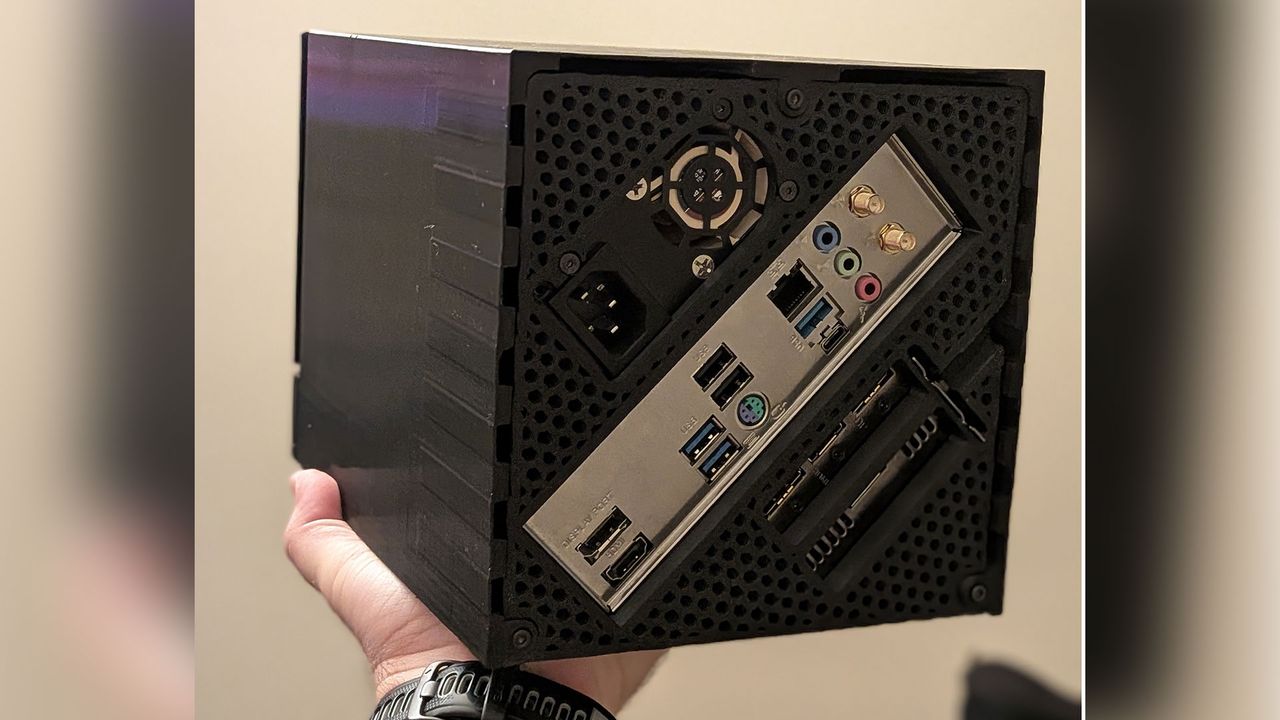
Valve’s Steam Machine may have disappointed fans with its availability and pricing, but a new 3D-printed alternative is turning heads with its clever design and community-driven approach. The Terk Box v1.1, developed by Jacob Terkelsen—an AMD engineer and former Tom’s Hardware contributor—and 3D printing enthusiast 3DCatt, closely mirrors the original console’s compact form factor while embracing a more flexible, DIY-friendly ethos.
The project emerged from frustration with the limited options for compact gaming PCs and the scalability challenges of off-the-shelf cases. Unlike traditional Mini ITX builds, the Terk Box v1.1 features a diagonally mounted motherboard, optimizing space for high-performance components in a footprint reminiscent of Valve’s design. The case supports a Mini ITX motherboard, an NVIDIA RTX 5060 graphics card, and a flex ATX power supply unit, balancing performance with portability.
A closer look at the Terk Box v1.1’s design
The Terk Box v1.1 measures 167 x 168 x 225mm, a slight step up from Valve’s original Steam Machine (152 x 162 x 156mm), but its internal layout prioritizes airflow and component compatibility. The case includes several thoughtful touches:
- - Diagonal motherboard mounting: This unconventional approach maximizes space for the GPU and PSU while maintaining a compact profile.
- - Enhanced ventilation: Initial revisions suffered from GPU thermal throttling, prompting the addition of rear ventilation to accommodate the RTX 5060.
- - Flexible component support: The design accommodates Mini ITX boards and GPUs up to approximately 180mm in length, though some users reported challenges with PCIe riser cable compatibility depending on their GPU model.
Terkelsen confirmed the build works with his RTX 5060 LP graphics card but noted room for improvement, including additional space for a front 140mm case fan. Both creators have hinted at further refinements in the upcoming v1.2 revision, signaling a commitment to iterative development.
Community-driven innovation and open-source potential
The Terk Box v1.1 is more than just a functional case—it’s a testament to the power of open-source collaboration. The creators have made the design files available under a Creative Commons license on Printables.com, complete with a detailed parts list and assembly instructions. This transparency invites enthusiasts to contribute their own tweaks, remixes, or suggestions, fostering a community around a project that fills a gap in the compact gaming PC market.
While the DIY approach offers flexibility, it also comes with trade-offs. The case’s current iteration requires careful component selection, particularly for GPUs and riser cables, to avoid fitment issues. Additionally, the pricing of individual parts—especially high-end GPUs like the RTX 5060—may limit its appeal to budget-conscious builders. However, for those already invested in 3D printing or PC modding, the Terk Box v1.1 presents an exciting opportunity to experiment with alternative form factors.
What’s next for the Terk Box?
With Valve’s Steam Machine lingering as a niche product, the Terk Box v1.1 offers a compelling alternative for enthusiasts seeking a compact, high-performance gaming PC. The creators’ openness to community feedback suggests that future versions could address lingering limitations, such as thermal performance or component fitment. Whether it evolves into a mainstream DIY alternative or remains a passion project, the Terk Box highlights the potential of community-driven innovation in the tech space. For now, it stands as a bold experiment—one that redefines what a compact gaming PC can look like.
AI summary
3D baskı ve Mini ITX teknolojisinin birleşimiyle ortaya çıkan Terk Box v1.1, Valve’in Steam Machine’ine rakip olabilecek kompakt bir PC tasarımı sunuyor. Kaynak dosyaları ve gereken parçalar hakkında detaylı bilgiler.